Individual Economists

Heavily Shorted Wendy's Soars After New CFO, Reddit Traders Pile In To Save Burger Chain

Zero Hedge -

Heavily Shorted Wendy's Soars After New CFO, Reddit Traders Pile In To Save Burger Chain

Heavily shorted Wendy's shares jumped as much as 22% in premarket trading on Wednesday, as a management shakeup and a surge of WallStreetBets activity around the struggling fast-food chain appeared to trigger a retail-driven squeeze.

The stock surge followed Wendy's appointment of former Potbelly CFO Steve Cirulis as CFO and chief strategy officer, as part of new CEO Robert Wright's turnaround effort for the fast-food chain, after shares had sunk 25% as of Tuesday's close.

Before joining Wendy's, Cirulis served as CFO and CSO for Potbelly Sandwich Works, departing from that role in December. He brings more than 30 years of experience across the retail and restaurant industries as the fast-food chain attempts to engineer a turnaround plan called "Project Fresh."

Outlet CFO Dive noted:

While at Potbelly — where he served overlapping tenures with Wendy's CEO Wright — he helped to lead a turnaround at the sandwich chain that boosted annual sales, CFO Dive sister publication Restaurant Dive reported at the time. Under Wright and Cirulis' leadership, Potbelly also saw a 500% jump in share price and improved its restaurant margin expansion and invested capital returns, Wendy's said Tuesday.

The Wright-Cirulis tag-team leadership shakeup at Wendy's appears to have sparked a retail-driven short squeeze, as short interest in the stock recently topped 31.8%, with about 4.7 days to cover.

This spark was likely fueled by Reddit-driven momentum piling into the beaten-down fast-food chain.

Activity on WallStreetBets:

Next GameStop? If so, risks mount whether the WEN CEO uses retail as a piggy bank through share sales. 

Tyler Durden Wed, 06/24/2026 - 08:55

Brent Falls To Pre-War Levels As Trump Contradicts Tehran On Hormuz Tolls, Nuclear Inspections

Zero Hedge -

Brent Falls To Pre-War Levels As Trump Contradicts Tehran On Hormuz Tolls, Nuclear Inspections

Brent crude oil prices fell below $75 a barrel late yesterday, marking the first time the global benchmark has traded under that level since the outbreak of the Trump-initiated Iran conflict.

The drop in crude prices could provide relief for consumers and businesses by easing pressure on fuel costs and inflation, a desired Washington outcome of the MoU signing - for which Trump has come under severe criticism from hawks at home. Speaking of escalating, we have another early morning Trump Truth Social statement, openly contradicting the consistent stated position of Tehran leaders.

Since the Switzerland high level talks led by Vance, there's been a series of issues where Tehran and Washington have issued clearly contradictory statements

Trump says in the fresh statement that Iran informed the United States that there would be "NO TOLLS, NO INSURANCE COSTS, & NO OTHER CHARGES OF ANY KIND" imposed on vessels traveling through the strategic waterway.

Trump as is typical criticized media reports that had suggested Iran could seek payments from ships using the route, calling such coverage "Fake News." He added that if the information provided by Iran proved inaccurate, ongoing negotiations between the two sides would end "immediately."

The president also denied reports that the United States had provided funds directly to Iran or released Iranian assets without conditions. "No money has been given to Iran, or released from their money to them, by the U.S.," he said.

However, Trump stated that Washington plans to make some Iranian funds available for agricultural purchases. According to the president, the money would be used to buy US farm products, including "Corn, Wheat, Soybeans, and more." But Iranian leadership has vehemently rejected this narrative too.

"Food is desperately needed in Iran," Trump said, adding that the purchases would be made "exclusively from the United States."

Oil drops to Iran war lows on the Trump Truth social statement...

The Strait of Hormuz remains one of the world's most important energy shipping routes, and any disruption or additional costs imposed on vessels passing through the channel could have significant implications for global trade and oil markets. It is officially 'open' in the wake of the MoU signing - but the next few days and weeks will be telling.

Meanwhile, some new developments on the Hormuz opening front, and Qatar LNG:

Qatar’s prime minister said establishing a hotline between the US and Iran is essential to prevent rogue actors impeding the reopening of the Strait of Hormuz, as he predicted that the Gulf state would resume normal liquefied natural gas production “within a few weeks” --FT

Trump is also asserting that Iran will allow IEAE inspectors in, something the Islamic Republic is also vehemently rejecting.

Tyler Durden Wed, 06/24/2026 - 08:40

Futures Rebound From "Chip-Wreck" Ahead Of Critical Micron Earnings

Zero Hedge -

Futures Rebound From "Chip-Wreck" Ahead Of Critical Micron Earnings

US stocks are set for a rebound with equity futures higher as Semis and Tech stage a partial recovery from yesterday’s "Chip-Wreck" as KOSPI retraced about 20% of its losses ahead of earnings from the single-biggest contributor to US outperformance this year: Micron’s third-quarter numbers are an even bigger deal than usual, following Tuesday’s shakeout of an overcrowded AI trade that’s has been priced for perfection. As of 8:00am ET, S&P 500 futures are 0.3% higher with Nasdaq 100 contracts up 0.5%. In premarket trading, equities are boosted by a bid for Semis (MU +3.6% with earnings tonight) with most of Mag7 higher. Within Cyclicals, Discretionary and Industrials are the standouts as Energy / Fins are mostly lower. Cyclicals poised to lead Defensives with Momentum factor flat. Bond yields are lower 1-2bp as the yield curve flattens, pushing 10Y yields ; USD remains bid even as real yields decline. DXY set a new 52-wk high today. Cmdty remain under pressure dragged by the Energy complex and weakness in Metals. Today’s macro data focus is on Home Sales ahead of tomorrow's update on GDP, PCE, Personal Income / Spending, Cap / Durable Goods, and weekly Claims.

In premarket trading, Alphabet (GOOGL) is up 0.5% after news the Google parent will replace Verizon in the Dow Jones Industrial Average. Verizon (VZ) is down 0.5%. Other Mag 7 stocks are mostly higher (Nvidia +0.6%, Tesla +0.6%, Meta +0.1%, Apple +0.6%, Microsoft -0.5%, Amazon -0.2%)

  • Cerebras Systems (CBRS) falls 14% premarket after the newly public chipmaker gave an annual sales forecast that disappointed investors looking for it to take a bigger slice of the AI data center market. 
  • FedEx (FDX) is down 7% after the parcel delivery company posted its first earnings report since completing the spin off of its freight unit earlier this month. Results seem to have fallen short of investor expectations after a strong run-up in the first half of the year: the company cited margin pressure and global trade uncertainty in its outlook.
  • FuelCell Energy (FCEL) rises 16% after the company said it reached an agreement with Fit Energy to supply 380 megawatts of clean on-site power for data centers using FuelCell Energy’s technology.
  • Hertz (HTZ) slumps 16% after providing an update. The company also filed to offer $100m of stock.
  • Twilio Inc. (TWLO) rises 3% as Goldman Sachs rates the software company buy with a Street-high $300 price target, citing AI tailwinds.
  • Wendy’s (WEN) rises 23% as the stock climbed the ranks in Stocktwits and Reddit’s widely followed wallstreetbets forum.

In other company news, Qualcomm is hosting a highly anticipated investor day in New York. CEO Cristiano Amon and executives are using the event to outline the company’s next phase of growth and diversification strategy. And Nike is hiring David Denton as its next CFO, who is poised to leave Pfizer in August. SpaceX shares are fluctuating, after it sold $25 billion of investment-grade bonds.

While yesterday’s market action was wild for some chip stocks, there was no sense of over-reaction or panic across the market, according to Goldman traders. They said that on a 1 to 10 scale of overall activity level on their trading floor, the session was a 5, despite broad selling by long only and hedge funds. They also say that top-of-book liquidity remains shallow, exacerbating price action. 

The recent swings are sharpening the focus on Micron, one of the biggest beneficiaries of roaring demand for chipmakers that stand to gain from the billions of dollars being plowed into AI infrastructure. The stock is up more than 260% in 2026 even after dropping 13% on Tuesday, and has been a leader of the rebound from the S&P 500’s war-driven lows. Today's main event, the Micron earnings print, follows four of the six major market-moving events on June’s calendar: the CPI print, the SpaceX IPO, the US-Iran MoU, and Warsh’s first Fed meeting. The bar is high, positioning crowded and the semi/memory complex is nervous.

“The main problem for Micron is not Micron itself, but the expectations for its third-quarter earnings,” said Joachim Klement, head of strategy at Panmure Liberum. “Even if Micron has a stellar quarter and gives solid guidance, it may not be enough to fulfill lofty expectations.”

Traders warned of possible further swings in tech stocks if Micron’s earnings and outlook fail to meet sky-high expectations.

“For high-performing companies that reflect the dynamics of a sector, market expectations naturally rise,” said Guillermo Hernández Sampere, head of trading at MPPM. “From a rational standpoint, these are difficult to meet, and disappointments become apparent in the stock’s price performance.”

Evidence of the vast amounts of capital flowing into the buildout of AI infrastructure and its supply chain was again on display as South Korea’s SK Hynix Inc. announced it was looking to raise $29 billion in a US listing. The offering would add to the recent wave of AI-related funding secured through stock issuances, after SpaceX held the largest initial public offering in history earlier this month and Alphabet Inc. planned a $85 billion capital raise.

The sixth and final major market event on the docket this month comes on Thursday, with this week’s marquee economic release, the core PCE. Bloomberg Economics expects that a hot PCE reading will likely reinforce the hawkish tilt by the Fed at its meeting earlier this month.

Building on the AI funding theme, SK Hynix Inc. is planning to raise 45.45 trillion won ($29.4 billion) in a landmark US listing. That could put it among the top five share sales of all time, comparable with Saudi Aramco’s then-record 2019 initial public offering.

In geopolitics, oil oil is down for an eighth day in nine and back at about $72 barrel, with Brent dropping below $75 for the first time since the start of the war, as crude continues to price for lower geopolitical risk, higher supply and increasing traffic through the Strait of Hormuz. Separately, Trump is meeting defense industry executives later to talk about picking up the pace of weapon production. Lower crude prices pushed the cost of diesel in the US below $5 a gallon for the first time since mid-March.

Private credit also remains in focus as a $7 billion fund run by Morgan Stanley caps investor withdrawals at 5%, allowing less than half of the redemptions shareholders requested in the second quarter.

Europe's Stoxx 600 index is little changed and Germany’s DAX is lagging following a big drop for defense company Rheinmetall. Asian stocks slid amid a selloff in the region’s leading chipmaker TSMC and other technology names over concerns about the sustainability of demand for AI-linked shares and their valuations. The MSCI Asia Pacific Index dropped as much as 1.2%, before paring most of the losses. Taiwan and Indonesia led the region’s decline, while Japan also underperformed. Indonesia’s stock benchmark fell as much as 3.7% after MSCI Inc. again decided to postpone its review on the country’s equities, saying it needs more time to see whether recently announced transparency reforms are effective. Sectors to Watch

  • Chinese semiconductor stocks rally as momentum in AI‑related investments lingered, while the news about TSMC lifting prices further lifts sentiment.
  • Australia’s software-heavy technology sector rises as investors rotate out of Asian chipmakers amid valuation concerns that triggered a selloff in AI-linked shares.
  • India’s software exporters are steadily losing their sway on the country’s stock market as concerns over artificial intelligence-led disruption trigger a prolonged selloff in the sector.
  • Chinese shipping stocks gain after more vessels transit the Strait of Hormuz with tracking signals switched on, signaling rising confidence in the vital energy chokepoint.
  • Chinese healthcare stocks advance after Citi says the sector’s current valuations fail to reflect improving fundamentals and resilient order books.
  • Citigroup says this year’s 6.18 campaign was the quietest in the past 16 years, which does not bode well for June retail sales data and suggests downside risks to second-quarter earnings estimates for JD and Alibaba.

In FX, the dollar continued to benefit from haven demand as risk sentiment remained fragile. Advancing 0.3%, the greenback headed for its longest winning streak in more than a month and cemented its highest level of the year. Meanwhile,  the euro has fallen to the lowest since May 2025

In rates, treasuries rose modestly as inflation worries eased, with the 10-year yield falling two basis points to 4.48% supported by similar gains for European bonds during the London session, as oil prices extend their recent slide with tankers openly crossing the Strait of Hormuz. US long-end yields are about 2bp lower with shorter maturities little changed, flattening 2s10s and 5s30s spreads by almost 2bp. 10-year is about 1bp lower near 4.47%, UK counterpart by an additional 1bp. Treasury auction cycle continues with $70 billion 5-year note; Tuesday’s 2-year sale stopped through by 0.3bp. WI 5-year yield near 4.265% is ~8bp cheaper than last month’s auction, which tailed by 0.1bp. The dollar issuance slate includes three names so far. SpaceX led a $30b, four-offering calendar on Tuesday. Issuers paid about 11bp in new issue concessions on deals that were 2.9 times covered. Focal points of US session include 5-year note auction at 1pm New York time. 

In commodities, WTI crude oil futures are down around 2% near session lows as the US and Iran signal progress toward ending the war, weighing on energy prices. Brent fell below $75 for the first time since the war started. Gold slipped as the stronger dollar made bullion priced in the US currency more expensive.

US economic data calendar includes 1Q current account balance (8:30am) and May new home sales (10am). Fed speaker slate includes Governor Lisa Cook at 2pm

Market Snapshot

Top Overnight News

  • Qatar’s prime minister said establishing a hotline between the US and Iran is essential to prevent rogue actors impeding the reopening of the Strait of Hormuz, as he predicted that the Gulf state would resume normal liquefied natural gas production “within a few weeks”. FT
  • The US Senate voted 50-48 to pass a resolution to halt the Iran war unless US President Trump gets approval from Congress. However, the White House said Congress resolutions on Iran are non-binding and won't be sent to President Trump, while Trump criticised the Senate passage of the Iran war powers resolution, which he claimed provides aid and comfort for the enemy.
  • Treasury Secretary Bessent said inflation will return to the target, and he is confident Fed Chair Warsh will optimize the path for the economy. Bessent also stated that the US housing issue is a conundrum affected by rate-lock owners, and will take lower rates and more supply, predicting inflation will ease as talks with Iran continue and gas prices fall. BBG
  • Congress on Tuesday passed its most-ambitious housing legislation since the 1980s, a package of more than 50 provisions aimed at making it easier to build homes and make housing more affordable. The House passed the bill 358-32 with broad bipartisan support a day after the Senate voted 85-5 to approve the measure. President Trump is expected to sign it into law as soon as Wednesday. WSJ
  • Leveraged ETFs tracking Samsung Electronics or SK Hynix probably sold a combined $6 billion of the Korean chipmakers’ shares yesterday to maintain their ratios, underscoring how such products are amplifying market moves. BBG
  • The BoJ sees the risk of inflation exceeding its 2% target and will conduct additional interest-rate hikes appropriately, Governor Kazuo Ueda said in speech Wednesday that reiterated policymakers’ recent messaging. BBG
  • Australia’s consumer price growth eased in May amid cooling fuel prices, but underlying inflation continued to strengthen as businesses passed on higher costs resulting from the Middle East conflict. WSJ
  • Extreme temperatures in Western Europe triggered widespread school and transit disruptions across the UK and France. The failure of two transformers in Brittany, probably due to the heat, left 68,000 people without electricity, while the UK’s grid operator issued a rare summer power-supply warning. BBG
  • Venezuela is set to reveal a $240bn debt pile, much higher than previously thought, as the country embarks on the biggest sovereign restructuring in history following the US removal of Nicolás Maduro. The country is on track to reveal borrowings that are significantly larger than market estimates of $150bn to $200bn when it lifts the veil for creditors on the state of its finances in the coming weeks. FT
  • SK Hynix plans to raise up to $29.4 billion in a landmark US listing to increase its capacity to meet memory chip demand. At that size, the deal would be among the top five share sales of all time. BBG

A more detailed look at global markets courtesy of Newsquawk

APAC stocks saw mixed price action as the initial rebound from the prior day's tech-driven sell-off gradually waned in the absence of any fresh major catalysts. ASX 200 traded rangebound as strength in tech and defensives was counterbalanced by losses in mining and energy following the recent declines in underlying commodity prices, while inflation data was mixed and would likely have little bearing on monetary policy. Nikkei 225 failed to sustain early gains and dipped back beneath the 70,000 level, while Services PPI data printed in line with forecasts and the BoJ Summary of Opinions showed members continued to advocate for further rate increases. Hang Seng and Shanghai Comp were indecisive as the attention turned to the WEF in Dalian, where Premier Li said China's economy shows resilience and maintains sound momentum. He stated China remains committed to opening up and will continue to accelerate the large-scale application of new technologies.

Top Asian News

  • Japan is reportedly looking at ways to streamline the management of its USD 1.3tln FX reserves to increase returns and help state finances, Reuters reported.
  • A draft proposal of 1% consumption tax was presented and will reportedly be implemented from April 2027, FNN reported. The proposal faces significant resistance from opposition parties, with DPP representative Furukawa stating they have no intention of cooperating, leaving the prospect of a June agreement uncertain.
  • Chinese Premier Li said China's economy shows resilience and maintains sound momentum, while he noted four key words for the economy including stability, innovation, dynamism and integration. Li also stated that China remains committed to opening up, as well as noted that China's AI sector sees explosive growth, and they will continue to accelerate the large-scale application of new technologies.

European bourses (STOXX 600 U/C) start Wednesday's trade broadly lower, with the AEX (+0.3%) outperforming as tech names steady from Tuesday's selloff. Germany's DAX 40 (-0.9%) is the clear underperformer, as Rheinmetall weighs on the index. The FT reported that Germany will scrap plans to build Rheinmetall's F126 frigates and instead purchase 8 Meko A-200 frigates from TKMS. Rheinmetall (-14%) has taken a hit following this news, while TKMS (+9.4%) benefits. European sectors print a mixed picture. Real Estate (+2.2%) is the clear outperformer, with Food, Beverages & Tobacco (+1.1%) and Consumer Products (+1.2%) rounding out the top 3. Media (-1.3%), Construction (-0.7%) and Energy (-0.6%) are the sector laggards.

Top European News

  • UK MP Jones said that while he has the 81 seats required to run, he will not contest against Burnham for Labour leadership, Sky News reported. Jones further said he thinks traders "can be content" with Burnham as PM and added that he thinks there is room to "borrow a little more", and things (referring to investment) can be done differently, without "broad brush" borrowing and spending.
  • Germany confirmed earlier reports that it will abandon plans to build 6 Rheinmetall (RHM GY) F126 frigates, and instead intends to buy 8 smaller Meko A-200 frigates from TKMS (TKMS GY).

FX

  • G10s are weaker against the Buck as the risk-off mood continues into Micron earnings this evening. Antipodeans lag, as the Aussie digests mixed CPI, JPY fluctuates either side of unchanged, and EMs are getting hit.
  • Markets are reluctant to buy the dip in equities after losses on Tuesday. As such, the Buck continues to firm as the preferred haven, with USD outperformance vs Scandis and Antipodeans with liquidity lower. Traditional havens fare better against the Buck, JPY steady at the lower end of its recent ranges, while CHF continues its downward trend. For US-specifics, the highlight of the session will be the Fed Bank Stress Test Report alongside Micron earnings - both due after the close. DXY trades at the upper end of its 101.35-101.68 range, higher by 0.2%.
  • Aussie data was mixed, CPI in May cooled below expectations, and the trimmed mean firming in line with most forecasts to 0.4% M/M and 3.6% Y/Y. The report noted housing was the main inflation pressure point, and Westpac analysis notes price pressures are broadening, particularly within services. As such, with the recent energy related prices pressures set to linger, the RBA will be keenly monitoring signs of sticky inflation with the bank widely expected to have concluded tightening. AUD faring better than Kiwi (AUD/NZD +0.1%), but lower against the Buck as the mixed data does not provide a bias towards any future easing/tightening; Labour market data ahead.
  • EUR and GBP are lacklustre and tracking the firmer Buck. Domestic catalysts light for both regions, though some continued incrementally optimistic updates from a likely incoming Burnham premiership which has helped GBP. EUR/GBP trades a whisker away from the 200 week moving average @ 0.8602 which is also the session low. For the EUR, recent Governing Council commentary remains hawkish, though nothing deviating too much from the Statement at June’s meeting.
  • Barclays sees a moderate dollar-buying by month-end against most majors, with a weak sign on USDJPY.

Fixed Income

  • Global fixed income benchmarks are slightly firmer, as energy prices continue to pull back and investors seemingly return to see bonds as a haven following the recent tech sell-off.
  • USTs (+2 ticks) return to gains after pulling back from a 109-17+ top in Tuesday's session, currently trading at the top end of a 109-09+ to 109-15 range. The US data docket is light today, ahead of Thursday's busy day (PCE, GDP, initial jobless claims, durable goods). On the supply front, the US is to sell USD 70bln 5-year notes. The auction benefits from a combination of higher outright yields, reduced geopolitical uncertainty and a more hawkish Federal Reserve. The key question will be whether the improved backdrop can bring direct bidders back into the sector while maintaining the strong indirect demand seen at the previous auction.
  • Bunds (+11 ticks) have been seen as attractive in recent sessions. Analysts see value in long-end German debt, with UBS stating that yields should be capped given any further hike by the ECB is expected to be quickly reversed as it would worsen the trade-off to growth, while rates strategists at Commerzbank say Bunds remain better supported as tech stocks struggle and worries of an AI-bubble. The German IFO data was mixed, with current conditions beating estimates while expectations came in soft; however, no move resulted. German 10yr yield has now returned to 2.90%, with Bunds currently trading at the top end of its 126.67-126.98 range.
  • Gilts (+18 ticks) outperform, supported by the lower energy prices and the removal of some political risk premium after Starmer's chief secretary (and former chancellor) Jones said he will not contest against Burnham for the top job. Jones also thinks the bond market can be content with Burnham as PM. Analysts at ING see limited upward risk in terms of rates, but state that political uncertainties are likely to keep upward pressure on gilts, especially the longer end. UK 10yr gilts currently in a 89.33-89.64 range.
  • Germany sells EUR 1.785bln vs exp. EUR 2bln 4.00% 2037 and 3.40% 2047 Bund.
  • The UK sells GBP 4.25bln 4.125% 2031 Treasury Gilt: b/c 3.47x (prev. 3.36x), average yield 4.284% (prev. 4.651%), tail 0.1bps (prev. 0.2bps).
  • Italy sells EUR 2.5bln vs exp. EUR 2-2.5bln 2.20% 2028 BTP and EUR 1.75bln vs exp. EUR 1.5-1.75bln 2.40% 2039 BTPei Auctions.

Commodities

  • In geopolitics, the US and Iran are continuing to finalise an agreement within the 60-day negotiation period. Amidst the talks, US President Trump reiterated that they are making a deal with Iran and will see how it goes. Currently, there are conflicting remarks made by US and Iranian officials. There appears to be disagreements surrounding the inspection of Iranian nuclear sites, and on potential tolling of the Strait of Hormuz.
  • WTI and Brent are continuing to decline, posting losses of c. 2%. This comes amidst the continued flow of ships traversing through the Strait of Hormuz, albeit still remaining far below pre-war levels. From an oil perspective, estimates suggest that around 6-7mln bpd of oil went through the Strait in the past few days (vs 20mln bpd pre-war). Elsewhere, focus has also been on comments via the Russian Deputy PM Novak, who stated that the country is mulling a diesel export ban, to help ease domestic shortages. Brent Aug’26 currently trades at the bottom end of a 75.53-77.00/bbl range.
  • Dutch TTF remains fairly steady, despite the Hormuz flows as focus remains on the heatwave across most of Europe. Attention has also been on French nuclear reactors, which typically need to be shut if the plant cannot cool itself efficiently. Already some EDF reactors have had to shut or taper output, but on the whole France’s national power grid operator said France has enough capacity to meet recent demand.
  • Spot gold continues to extend on Tuesday’s losses, and has made a WTD trough at 4,050.47/oz (vs USD 4,115/oz peak). Action which is a continuation of recent losses, stemming from the hawkish repricing at the Fed, stronger USD/higher yields and as sell-side banks continue to trim their PT for the yellow-metal. 3M LME copper trades at the lower end of a USD 13,358-13,483.1/t range.
  • US Private Inventory Data (bbls): Crude -0.8mln (exp. -5.0mln), Distillates +1.4mln (exp. -0.4mln), Gasoline +1.2mln (exp. -0.4mln), Cushing -1.0mln.
  • US President Trump commented that the big oil companies are not dropping their prices at the pump commensurate with the lower prices they are paying for oil and customers are being 'gouged', while he has instructed the DoJ to look into this and stated that gasoline prices better start going down a lot faster than he is seeing.
  • Qatar's PM and Foreign Minister said that the country will resume normal LNG output within weeks, according to the FT.
  • Jera Chairman said that restoring Qatar’s LNG facilities, which were damaged during the Iran war, may likely take more than two or three years.

Trade/Tariffs

  • Brazil will maintain its scheduled tariff hikes on imported electric and hybrid vehicles, with a 35% import tax on assembled and semi-assembled EVs taking effect in July, while disassembled vehicles will face the same rate from January 1st, 2027. Brazil will also introduce additional zero-duty import quotas for disassembled and semi-assembled EVs starting July 1st, providing limited relief for automakers amid higher import barriers.

Central Banks

  • BoJ's Ueda said the timing and pace of future hikes will be decided by scrutinising the likelihood of baseline forecasts materialising, as well as risks. He added that there is risks that underlying inflation may overshoot 2%, but that Japan's economy is recovering moderately albeit with some weakness. Financial environment remains accommodative after recent rate hike; continues to support economic activity.
  • BoJ Summary of Opinions from the June meeting noted a member said it has become more appropriate to adjust the degree of monetary support as FX moves are pushing up import prices, and a member said it is appropriate to continue raising interest rates as financial conditions are accommodative. There was also the opinion that even after a June rate hike, the BoJ must maintain its stance of proceeding with further rate hikes if the economy and prices move in line with forecasts. The Summary of Opinions also stated they must push up the BoJ's policy rate closer to the neutral rate as soon as possible and to near neutral at an early date to avoid big and sharp rate hikes in the future. Furthermore, a member said Japan's neutral rate is seen at around 2%, and the BoJ must raise its rates once every few months, while a member said there was no reason for the BoJ to halt a reduction in its JGB purchases.
  • RBA’s Hauser said that there have been important economic developments since May and not least the chance of a US-Iran deal. Hauser said the RBA took proactive policy action to reduce excessive capacity pressures through rate hikes, while timely policy steps to reduce inflation could have lower unemployment costs. The RBA still has work to do to reduce inflation, which remains far too high.
  • Riksbank Minutes (Jun): Governor Thedeen said it is reasonable to indicate that it is now somewhat more likely that we will raise the policy rate in the future. I think that this forecast is still reasonable, given the signals now coming with regard to a solution to the war between Iran and the United States.

Geopolitics: Middle East

  • Pakistan's Foreign Ministry said it is conducting communications between US and Iran to effectively implement the MoU and that technical talks will continue next week; potentially Monday or Tuesday.
  • Israel and Lebanon are in talks on a US-supported pilot project involving the withdrawal of Israeli troops from some parts of southern Lebanon and hand it over to Lebanese forces, according to several Israeli officials.
  • Iranian Parliament Speaker Ghalibaf said Iran extends its hand of brotherhood and cooperation to all countries in the region and is ready to establish security agreements with all countries in the Middle East.
  • Iranian senior commander said Iran's military has shifted to an aggressive doctrine.
  • Oman established a temporary shipping lane in the Strait of Hormuz, according to IRNA. Furthermore, the Maritime Security Center in Muscat said Oman coordinates with the IMO for ships to pass through the Strait of Hormuz "without fees", according to Al Jazeera.
  • Israeli Military reportedly preparing for redeployment in southern Lebanon, Al Hadath reported citing Maariv.
  • Israeli tanks advanced towards Beit Yahoun in Lebanon, with heavy gunfire reported near Beit Yahoun and Kounin, while it was also reported that Israeli strikes hit the Lebanese coastal city of Tyre. Furthermore, Israeli fighter jets reportedly attacked a school in the At-Tuffah neighbourhood in eastern Gaza, and Israeli military entered Syria's Quneitra province.

Geopolitics: Ukraine

  • Russia is reportedly considering a new wave of mobilisation as early as October 2026.
  • Russia gas plant in Orenburg was targeted overnight by drones, Kyiv Post reported.

Geopolitics: Other

  • North Korea leader Kim Jong-un said North Korea will build two Choe Hyon-class warships annually over the next five years, as it advances the nuclearisation and strategic expansion of its navy, while Kim said they will equip their destroyers with nuclear weapons.

US Event Calendar

  • 7:00 am: United States Jun 19 MBA Mortgage Applications, prior -3.8%
  • 8:30 am: United States 1Q Current Account Balance, est. -208.9b, prior -190.74b
  • 10:00 am: United States May New Home Sales, est. 639.89k, prior 622k
  • 2:00 pm: United States Fed’s Cook Gives Pre-Recorded Opening Remarks

DB's Jim Reid concludes the overnight wrap

After chipmakers led a continued US tech sell-off last night, the market mood is more mixed in Asia this morning. Korea’s KOSPI (+0.82%) is rebounding after yesterday’s sharp -9.99% drop, initially rising around 4% as heavyweights Samsung (+4.35% vs. -12.90% yesterday), recover, although SK Hynix (-2.96% vs -13.18% yesterday) continues to hover around its losses. Elsewhere, the Nikkei (-1.80%) is registering a steeper decline, while China is mixed with the CSI 300 (+0.12%) up and the Shanghai Composite (-0.25%) down. The Hang Seng (+0.04%) and Australia’s S&P/ASX 200 (+0.07%) remains marginally flat. And this morning, US equity futures have risen, with those on the S&P 500 (+0.17%) pointing to a modest recovery after the index fell -1.44% yesterday, while Nasdaq 100 futures are up +0.39%. 10yr USTs are also -1.2bps lower and hovering around 4.49% as we go to print.

Elsewhere this morning, the yen is hovering near its weakest since 1986 (161.55 against the US dollar) as concerns that Japanese authorities may intervene to curb further losses continues. The yen’s low follows the BoJ’s latest summary of opinions that came out earlier overnight, where policy members continued to press for further rate hikes after the group raised Japan’s policy rate to 1% last week, although the summary did not mention when the likely timing of the next move will be. As a reminder, our Japan economist forecasts the next BoJ hike to be this October, followed by quarterly hikes thereafter until reaching 1.75% in April 2027. 10yr JGBs (+0.4bbps) are slightly higher as I type.

We also had overnight data that showed Australia’s CPI rose +4.0% y/y in May (vs +4.3% est and +4.2% prior). Trimmed mean CPI edged up to +3.6% y/y from +3.4% prior. So while the softer headline suggests easing inflation—helped by lower oil prices amid easing US–Iran tensions—underlying pressures remain sticky, likely keeping the RBA on a hawkish footing.

Ahead of those overnight developments, markets saw a classic risk-off move yesterday, with equities sliding and bonds rallying. The main catalyst was another selloff in tech stocks, and chips in particular. Indeed, the Philly semiconductor index (-7.87%) saw its biggest fall since the jobs report at the start of the month, back when it fell over -10% in a single day. This decline included Sandisk (-13.64%) and Micron (-13.18%) as the two worst performers in the S&P 500 yesterday, though they remain among top four performers YTD. Given the importance of semiconductors for US equities, that dragged down the broader indices, with the NASDAQ slumping -2.21% yesterday, whilst the S&P 500 fell -1.44%. Indeed, the concentration of the decline was striking, as it was the first time this year that the S&P 500 was down more than 1% on a day when majority of companies in the index were actually higher. Over in Europe, the divergence wasn’t quite so marked, but the STOXX 600 (-0.73%) still posted its worst day in three weeks as tech stocks led the declines.

Interestingly, this equity weakness happened despite a couple of good news stories on the economy yesterday. The first was the flash PMIs for June, which generally surprised on the upside, suggesting that the global economy was still coping better with the energy shock than many expected. Indeed, the US composite PMI hit a 5-month high of 52.2 (vs. 51.1 expected), a level we haven’t seen since the Iran conflict began. And in the Euro Area, the composite PMI also rose more than expected to 49.5 (vs. 49.2 expected), so collectively the numbers painted a decent narrative about the global economy at the end of Q2.

On top of the PMIs, yesterday also saw a fresh tailwind in the form of lower energy prices, with Brent crude (-1.05%) down to a 3-month low of $77.08/bbl. That came as investors remained hopeful that the shipping through the Strait of Hormuz would normalise before long, with data pointing to more vessels going through, even if they’re only creeping up slowly. On the topic of the Strait of Hormuz, we also have a DBRI note (link here) looking at the path to normalisation, the implications, and an analysis of the different sectors impacted by the closure. It's a collaboration between numerous macro and micro analysis and is a comprehensive look at where various products and sector are after several weeks of the strait being closed and now reopening.

 With oil prices coming down, that helped to ease fears about stagflation considerably. In fact, the US 1yr inflation swap (-7.1bps) fell to just 2.28%, which is actually beneath its level before the Iran conflict began. And similarly, the Euro 1yr inflation swap (-8.0bps) fell to 2.45%, its lowest since early March. So that led investors to price out the chance of rapid rate hikes this year, with futures pricing 38bps of Fed rate hikes by December, down -3.0bps from its cycle high the previous day. And for the ECB it was much the same story, with just 31bps of cuts priced by December, down -1.1bps on the day.

That backdrop of lower oil prices, easing inflation fears, and more dovish rates pricing was very supportive for sovereign bonds. In fact, the 10yr bund yield (-3.2bps) hit a 3-month low of 2.92%, whilst yields on 10yr OATs (-2.8bps) and BTPs (-1.0bps) also fell. That came in spite of comments from ECB chief economist Lane, who said that ECB officials faced the risk of inflation remaining above target “for quite some time”. But ultimately, the deflationary impact of lower oil prices helped to ease fears about a more hawkish response yesterday. Indeed, US Treasuries saw a similar impact, with the 10yr yield (-1.2bps) slipping back to 4.50%.

One exception from the largely positive data picture was Germany, whose flash composite PMI fell to 48 from 48.8 in May, notably below the 49.7 expected with services being the main drag. However, the survey was before the MoU was signed between the US and Iran so analysts will be looking for a recovery in the final figures. Staying with Germany, Marion Muehlberger highlights a positive surprise in the pension reform plans announced yesterday. Her piece (link here) discusses the introduction of a mandatory funded component, with an additional 2pp of gross salaries to be invested in a centralised public pension fund, phased in gradually until 2031. This is expected to result in around €35bn of additional investment into capital markets, with no pre-defined asset allocation or country split. Sweden’s “premium pension” serves as a model. As well as improving the sustainability of Germany’s public pension system in the context of an ageing population, this could also provide a meaningful boost to German and European capital markets.

Here in the UK, gilts outperformed yesterday after the flash PMIs were also weaker than expected. The composite PMI unexpectedly fell to 49.4 (vs. 50.5 expected), meaning it was still in contractionary territory. So coupled with the decline in oil prices, that led to growing doubt about a Bank of England rate hike happening this year. In turn, that meant the 10yr gilt yield fell -5.4bps to 4.75%, a bigger decline than the other big European economies. Meanwhile on the political scene, Andy Burnham is still the only declared candidate at present to become the next Labour leader and PM. So if that stays the case (and any candidate still needs 20% of Labour MPs to nominate them), Burnham could theoretically become the new leader as soon as mid-July.

Looking at the day ahead, and data releases include the Ifo’s business climate indicator from Germany, and US new home sales for May. From central banks, we’ll hear from the ECB’s Nagel, Cipollone and Moulin, along with the BoE’s Breeden and Dhingra. Finally, today’s earnings include Micron.

Tyler Durden Wed, 06/24/2026 - 08:25

Mamdani-Backed Candidates Win New York House Primaries

Zero Hedge -

Mamdani-Backed Candidates Win New York House Primaries

Authored by Nicholas Zifcak & Jackson Richman via The Epoch Times,

All three candidates endorsed by New York City Mayor Zohran Mamdani won their closely-watched House primary races on Tuesday, handing the democratic socialist a victory in his bid to move his party more to the left.

Democratic congressional candidate Brad Lander (R) arrives with New York City Mayor Zohran Mamdani for an election night watch party in New York City on June 23, 2026. Ryan Murphy/AP Photo

On the job for fewer than six months, the mayor waded into three congressional primary races, backing democratic socialists and progressives against more established Democrats.

Mamdani-endorsed former New York City Comptroller Brad Lander defeated Rep. Dan Goldman, whose seat spans lower Manhattan and part of Brooklyn.

In the race to succeed retiring Rep. Nydia Velazquez, Mamdani-endorsed Assemblymember Claire Valdez, a self-described democratic socialist, beat Brooklyn Borough President Antonio Reynoso, who was backed by Velazquez.

Rep. Adriano Espaillat, 71, was defeated by Mamdani-backed Darializa Avila Chevalier, 32, a democratic socialist.

Mamdani's endorsements had put him at odds with other prominent New York Democrats. New York Gov. Kathy Hochul endorsed Espaillat and campaigned alongside Goldman.

In these solidly blue districts, primary elections are highly competitive, with the Democratic contender expected to win easily in November.

Community Organizer Beats Rep. Espaillat

In an upset, PhD student and community organizer Chevalier beat out fellow Dominican, Congressman Espaillat. The district, which includes Harlem and parts of the Bronx, has been represented by Espaillat since 2017.

Chevalier received a significant boost when Mamdani announced his support for her candidacy in late May. Even so, in a debate just days before the primary, Chevalier faced pointed questions about past Twitter posts in which she attacked major Democratic party leaders, including former President Joe Biden (who she called "racist"), as well as cursing former Vice President Kamala Harris. She also called the United States "a[n expletive] disgrace," and called for the end of the police.

Chevalier has been outspoken against Israel, criticizing Espaillat for accepting funds from the American Israel Political Action Committee (AIPAC). Espaillat criticized her for attending a pro-Palestinian rally just one day after Hamas's Oct. 7, 2023, attacks on Israel.

Chevalier worked on the mayor's campaign last year.

Assemblymember Valdez Wins

Mamdani-endorsed Valdez beat Reynoso for the Democratic nomination for the seat of retiring Velazquez.

The veteran Hispanic congresswoman representing Brooklyn and Queens was an early supporter of Mamdani, and was displeased when the mayor endorsed Valdez rather than her preferred candidate, Reynoso, for the seat she is vacating. Up and down the ballot, Velazquez endorsed a string of candidates running against Democratic Socialists of America candidates.

Democratic Socialists of America member Valdez was an early supporter of Mamdani since late 2024 when he first launched his run for mayor. She received Mamdani's endorsement in January.

Rep. Goldman Defeated by Lander

Lander succeeded in beating out Goldman for the Democratic nomination to represent the 10th district in Congress.

Lander, who also received Mamdani's endorsement, was a vocal Mamdani supporter after his run for mayor ended with the June 2025 primary. Lander has joined some current House members in calling for an end to U.S. aid for Israel.

Both candidates have described themselves as liberal Zionists, but Lander has attacked Goldman for supporting U.S. military aid to Israel and for accepting money from AIPAC.

The Epoch Times spoke with voters in the 10th district. Michael Bedrick said he mainly came to vote to support Goldman, who he said has earned his vote.

"I'm really kind of sick of the left's attack on Israel," Bedrick, an attorney, said.

"I understand there's a lot of problems with the Israeli government itself, but I want our interests aligned with democracies and not with Islamic fundamentalists."

Another voter in the 10th District, Benjamin Patrusky, said affordability was his primary concern. He said he was looking for progressive candidates who would work to push out President Donald Trump.

"Anyone who's a strong progressive and leaning in the right direction, and has a forceful voice, will be important to me," Patrusky said.

Lander received 65.8 percent of the vote to defeat Goldman, with 86 percent of the votes counted.

Lasher Wins Primary for Nadler's Seat

State Assemblyman Micah Lasher beat out seven other candidates for the nomination to replace retiring Rep. Jerry Nadler (D-N.Y.).

The race attracted a field of eight candidates. The two state assemblymen, Lasher and Alex Bores, stood out. Lasher received endorsements from former bosses Nadler, Michael Bloomberg, and Hochul; while major unions UAW, AFL-CIO endorsed Bores along with Rep. Patrick Ryan (D-N.Y.). Other candidates in the race included former Republican and never-Trumper John Conway, USAID public health expert Nina Schwalbe, and John F. Kennedy's grandson Jack Schlossberg.

Schwalbe, who spoke with The Epoch Times at a polling station, said voters in the 12th District are concerned about housing and healthcare.

"People are losing their Medicaid benefits. They're getting these letters about work requirements. They're losing their SNAP benefits," Schwalbe said.

Schwalbe said she and her campaign have knocked on 4,000 doors.

"And then people are worried about rule of law and the existential crisis of Trump," she said.

Even so, the issue of regulation of artificial intelligence (AI) played an outsize role in the campaign.

In a video, Bores called the contest a referendum on the regulation of artificial intelligence (AI). Bores previously worked at Palantir and helped pass a state law last year called the Raise Act, requiring AI developers to publish safety plans.

New York's 12th Congressional District encompasses the Upper West and Upper East Sides in Manhattan. In the state assembly, Bores represents the Upper East Side and Lasher represents the Upper West Side.

Lasher has a long history in New York politics, working as director of policy for Hochul prior to becoming a state legislator. He also worked as chief of staff to the state attorney general, as well as legislative director for former Mayor Michael Bloomberg.

Voters in the 12th District shared their thoughts on the election with The Epoch Times.

Shaughna Bishop, a psychologist, said one of the main things that guides her vote is LGBTQ rights. For this election, she said the debate over regulating AI also impacted her decision, which wouldn't normally be the case. She also considered a candidate's experience as a legislator in local government. "Jack Schlossberg is cute, but he hasn't done anything." Bishop decided to vote for Alex Bores.

Her son Cole Bishop, who also voted on June 23, said regulating AI was the most important issue for him. "I am probably much more motivated by the debate on AI. I think the rapid consumption of our clean water is going to be devastating."

Michelle Roseblatt, retired, another voter in New York's 12th District, said it's important to vote. "It's our duty. It's an honor to vote. People die and give their lives in other countries to vote," Roseblatt said.

"All those new voters who signed up in the mayoral election, where are they now? Are they sitting this out? Because every election is as vital as the last one."

Army Veteran to Challenge Rep. Lawler

Incumbent Republican Rep. Mike Lawler will face Army veteran Cait Conley.

Conley won the Democratic primary, defeating Rockland County Legislator Beth Davidson, Tarrytown Trustee and nonprofit executive Effie Phillips-Staley, and journalist Mike Sacks.

Lawler has represented the district, based in the Hudson Valley, since 2023.

The Cook Political Report rates the race as a toss-up.

Trump-Backed Candidate Wins Primary for Rep. Stefanik's Seat

Manufacturing executive Anthony Constantino defeated New York State Assemblymember Robert Smullen. President Donald Trump endorsed Constantino.

Dairy farmer Blake Gendebien won the Democratic primary.

Whoever wins will succeed Republican Rep. Elise Stefanik, who declined to run for re-election.

Shaughna Bishop and her son Cole Bishop said the debate over regulating artificial intelligence affected their decision. They voted in Manhattan, N.Y., on June 23, 2026. Nick Zifkac/The Epoch Times Tyler Durden Wed, 06/24/2026 - 08:05

Chip Party Must Go On: SK Hynix To Raise $29 Billion In US Listing

Zero Hedge -

Chip Party Must Go On: SK Hynix To Raise $29 Billion In US Listing

About two days after a Chosun media report from South Korea sparked a global sell-off in memory stocks and triggered a 10% crash in the Kospi, a new report states that memory giant SK Hynix is planning a massive $29.4 billion US listing. This move will test investor appetite for another mega AI-linked offering and demonstrate whether markets can absorb another massive listing weeks after the SpaceX IPO.

Bloomberg reports the offering would be the largest U.S. listing by a Korean firm and the biggest ever via American Depositary Receipts, easily exceeding Alibaba's $25 billion 2014 debut.

The offering is being led by Bank of America, Citigroup, Goldman Sachs, and JPMorgan. SK Hynix is at the center of the AI infrastructure buildout, serving as one of the top suppliers of high-bandwidth memory chips used in AI chip stacks at data centers.

The listing gives SK Hynix access to a much broader and more liquid US investor base, which could help narrow its valuation discount to Micron - similar to how TSMC's ADR listing attracted global flows and sustained a premium valuation.

UBS analyst Nicolas Gaudois's first take on the news:

Headline:

ADR listing targeted 10 July, to raise up to Won45tn, 17.8m shares (1 to 10 ADRs; 2.5% of outstanding).

Our Take:

Size/timing in line with investor expectations. We expect SKH to buy back shares to maintain SK Square ownership >20% (currently 20.5%). We believe SKH will continue to buy back and possibly issue some in the US to provide more liquidity over time.

CLSA Analyst Sanjeev Rana said the US listing of SK Hynix will help boost liquidity in the stock and propel a further rally.

"If they can get at least a valuation multiple similar to Micron, for example, then the local shares also need to reflect that, so that kind of expectation is there," Rana said. "I wouldn't be surprised if this rally continues."

Pictet Asset Management analyst Jon Withaar said, "A large part of the motivation behind this is no doubt the success of TSMC ADR which is very liquid, trades at a persistent premium to the Taiwan line and is accessed readily by globally investors."

"While we might see some sell on the news, the news is overall positive for SK Hynix," said Kevin Net, head of Asian equities at Financière de l'Echiquier. "The listing will help SK Hynix receive more funding for further investment, and it will also drive higher probability for more shareholders return and reduce valuation discount to Micron."

Meanwhile on Tuesday:

Surging demand for HBM chips has sent SK Hynix shares in Seoul soaring, with retail investors piling into chip trades. The stock has climbed about 306% this year, pushing the company's market value above $1.2 trillion.

To keep that momentum alive, SK Hynix now appears to be turning to the US investor pool. Its planned US listing, expected to begin trading on July 10, would certainly provide a more direct way to buy into the HBM boom.

Tyler Durden Wed, 06/24/2026 - 07:45

Tanker Owners Having The Best Week Of The Hormuz Crisis As VLCC Rates Soar

Zero Hedge -

Tanker Owners Having The Best Week Of The Hormuz Crisis As VLCC Rates Soar

By Julianne Geiger of OilPrice.com

The Strait of Hormuz may be reopening, but don't tell tanker owners the crisis is over. They're making too much money.

As Middle Eastern producers scramble to move crude that has spent months stranded in the Persian Gulf, tanker rates have exploded higher, turning a slow return to normal into a windfall for shipping companies.

According to Reuters, the cost of hiring a tanker in the Gulf has nearly doubled in just a week, jumping from around $106,000 per day to more than $190,000 per day. For some very large crude carriers (VLCCs) hauling cargoes through Hormuz, daily earnings have surged to nearly $470,000—a level that would have seemed absurd before the war began.

Oil prices have spent much of the past week falling as traders price in the return of Middle Eastern supply, with Brent futures trading at $77 on Tuesday afternoon. Meanwhile, the people actually moving that oil are charging some of the highest rates seen during the entire crisis.

There still aren't enough ships.

Even after Iran lifted its effective blockade last week as part of the 60-day ceasefire agreement with the United States, traffic through Hormuz remains well below normal levels. Before the war began in late February, roughly 125 ships passed through the chokepoint each day. Current traffic remains a fraction of that.

At the same time, roughly 100 tankers are still trapped inside the Gulf carrying cargoes loaded during the conflict.

Now producers want their barrels moving again.

Abu Dhabi's ADNOC has been aggressively marketing crude cargoes, while refiners in major importing nations such as India are seeking additional Middle Eastern supplies after months of disruption. The result is a sudden surge in demand for ships just as vessel availability remains unusually tight.

The futures market has largely moved on from the crisis, but the shipping market clearly hasn't.

Until more vessels begin moving through the world's most important oil chokepoint, tanker owners may remain among the biggest winners of a conflict that cost almost everyone else dearly.

Tyler Durden Wed, 06/24/2026 - 07:20

Rheinmetall Plunges After Germany Scraps Warship Order

Zero Hedge -

Rheinmetall Plunges After Germany Scraps Warship Order

Rheinmetall shares plunged as much as 17%, the largest intraday drop in more than a year, after the Financial Times reported that Berlin has scrapped a multi-billion-euro program to build six F126 frigates.

The German Ministry of Defense told FT on Wednesday that the decision was due "to significant delays in the project, foreseeable cost increases and the risks that would have been associated with a change of main contractor," adding that changing the contractor would have added even more costs but also required the government to contractually "waive potential claims for damages against the previous contractor".

The ministry noted that it now plans to procure eight MEKO-200 frigates from TKMS instead. "Sea-based anti-submarine warfare is of the utmost importance within NATO and is therefore also a national priority," it said.

TKMS shares in Germany jumped 10% on the news.

Morgan Stanley analyst Marie-Ange Riggio said the report was a surprise, especially because Rheinmetall had been confident it would secure the contract before summer.

Riggio said it raises questions about German defense procurement visibility and Rheinmetall's near-term naval ambitions, but it should not materially affect current guidance because deliveries were not expected until 2031, leaving a limited impact on 2030 targets.

Here is Citi analyst Charles Armitage's first take on the news:

It has been widely reported (Bloomberg, 24/6/26, here) that Germany will cancel the F126 frigate program (and buy 8 MEKO frigates from TKMS instead, 4 more than previously). We have been cautious of Rheinmetall's ability to ramp Naval sales up to Eur5bn by 2030 and forecast Eur2.5bn sales in 2030 (see Figure 38 of our initiation report, which also gave Eur115 of further upside if Eur5bn sales were to be obtained) – following the reported cancellation, this seems more likely (with our existing group forecast of Eur37bn sales in 2030 also looking more valid).

Two points: 1) our valuation of Eur1,000-1,100 per share for the non-ammunition business still stands, plus Eur300-500 per share for the ammunition, giving our Target Price of Eur1,408, which remains valid; 2) that said, the incremental news today would appear to call the Naval targets into question – suggesting an estimated ~Eur115 downside risk to the share price.

Barclays analyst Afonso Osorio says, "This comes as a surprise, weighs on sentiment, and raises questions about how quickly defense spending will evolve."

Tyler Durden Wed, 06/24/2026 - 06:55

10 Wednesday AM Reads

The Big Picture -

My mid-week morning train WFH reads:

•  I want to be in the same business as Leopold “Lumpy” Aschenbrenner: A skeptical look at the AI-fund gold rush and the boy-genius mystique funding it. The title alone earns the click.  (Old Rope Research)

A smaller Fed megaphone: Kevin Warsh: a man of few words. Kevin Warsh, the new Fed chair as of last month, is aiming to reshape the Fed’s approach to transparency. Fewer projections, fewer pressers, fewer pontifications. More task forces, apparently.  On whether the Fed should talk less. A timely argument about communication as a policy tool that may be losing its potency. (OptimistiCallie) see also Will the Shadow Fed Chair Please Stand Up? Kevin Warsh may want a quieter Fed, but markets will fill the silence, just less reliably and at a high cost. On the awkward spectacle of a Fed-chair-in-waiting jawboning policy before he’s been sworn in. The shadow-chair gambit, dissected. Kevin Warsh may want a quieter Fed, but markets will fill the silence, just less reliably and at a high cost. (Stay-At-Home Macro)

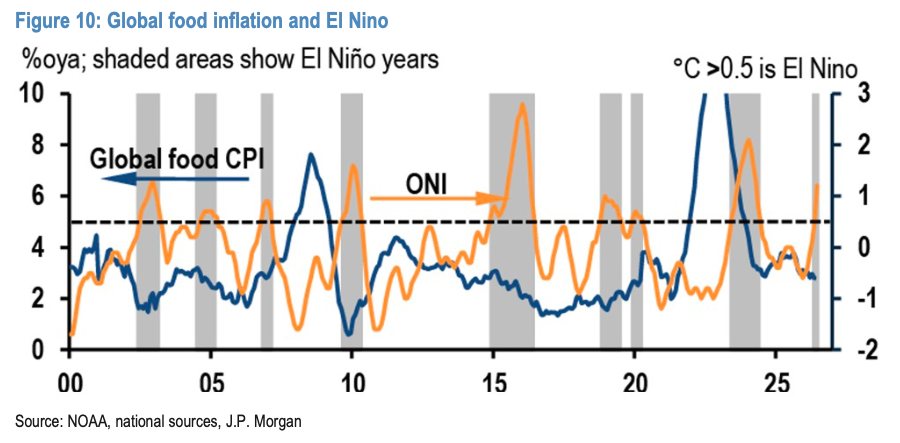
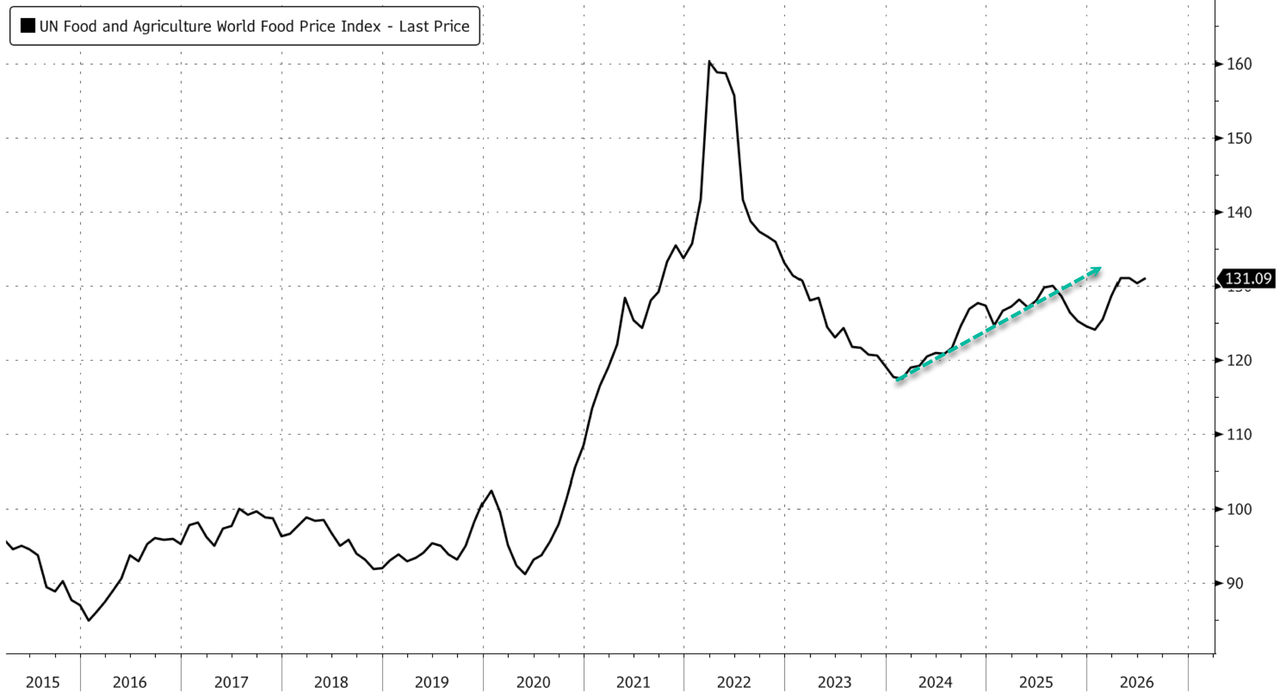
What Climate Change Costs You at the Checkout: The higher temperatures climb, the more inflated household costs like groceries will become, economists predict. Bloomberg on the climate component of food inflation — coffee, chocolate, tomatoes, citrus. The bill is itemized now. (Businessweek)

•  Stocks make the rich richer. Everyone else, not so much: The wealth effect is real, but it’s concentrated where the assets are. Axios on why a roaring market and a strained household can coexist. (Axios)

Elon Musk and The Rise of Cult Capitalism: On how parasocial CEO worship became a structural feature of public markets. Whether you find the framing fair or unfair, the data is real. Every billionaire is a policy failure. The first trillionaire is also a market failure (On Data and Democracy)

The Brexit Vote Ten Years On. We used to think we could have both liberalism and democracy. Now we are forced to choose between them. Adam Tomkins offers a more sympathetic post-mortem than most. Read it against the New Republic and Axios takes for a fuller picture of the argument that won’t die. (Civitas Institute) see also Ten Years After Brexit, Every Grim Prediction Has More Than Come: True As the sixth prime minister since the historic vote calls it quits, most Britons agree it’s been an epic disaster. But in the next election, things may get even worse. A decade on, the receipts are in — and they’re not flattering.  (New Republic)

Why Are LLMs Smart?  The amount of intelligence required to compose one coherent sentence can almost be reduced to the rules in a grade-school grammar book. But the amount of intelligence needed to produce a string of sentences focused on one topic — a paragraph — far exceeds any rules. And the amount of intelligence wrapped up in a string of paragraphs, as in a conversation, begins to approach a pattern we call “thinking.” As researchers scaled up the size and scope of LLMs, they were stunned to find that their systems could begin to imitate the elemental patterns of human thinking found in paragraphs and conversations. Sober and curious rather than hyped. (Kevin Kelly)

The Former GOP Operative Running a News Site for the ‘Politically Homeless’: WSJ profiles Sarah Longwell and the Bulwark’s business model built on disaffected Republican readers. The audience is real and growing. the Bulwark is a profitable startup, and it approaches the news with a raw candor subscribers crave (Wall Street Journal)

Why .400 Hitters Disappeared — and What It Means for AI: Kedrosky borrows Stephen Jay Gould’s classic argument — hitters didn’t get worse, the whole league got better — and aims it at AI. A smart frame for thinking about shrinking variance. (Paul Kedrosky)

It’s Known as the Meat Wall—and It Could Be the Hack to World Cup Glory: The WSJ on soccer’s latest marginal-gains obsession. File under: things you didn’t know elite athletes argued about until now. (Wall Street Journal)

Video of the day: 26 Minutes Of Hilarious Clarkson’s Farm Mishaps | Clarkson’s Farm Seasons 1-4

Be sure to check out our Master’s in Business with Seth Klarman, CEO and portfolio manager of The Baupost Group. Founded in 1982 with $27 million in seed capital, over the past four decades, Baupost has grown to $22 billion, with annual net returns of over 20%. The legendary investor is known for his patient, risk-averse, and contrarian approach to finding deeply discounted securities across equities, distressed debt, and real estate.  He is the author of Margin of Safety (1991) and the editor of the 7th edition of Security Analysis (2023).

Gold and Silver Are Down Substantially From Recent Highs

Source: YCharts


Sign up for our reads-only mailing list here.

The post 10 Wednesday AM Reads appeared first on The Big Picture.

AI Reshaping US Jobs But Not Yet Triggering Mass Unemployment, Says European Central Bank

Zero Hedge -

AI Reshaping US Jobs But Not Yet Triggering Mass Unemployment, Says European Central Bank

Authored by Owen Evans via The Epoch Times,

Artificial intelligence (AI) has begun shifting American workers away from occupations most vulnerable to automation, but its overall effect on U.S. employment and wages still remains “muted,” according to a European Central Bank study released on Monday.

U.S. companies have been investing heavily in AI in recent years amid predictions that humans will be ​replaced at increasing rates.

According to the European Central Bank (ECB) Economic Bulletin article, certain workers, especially junior staff in highly exposed sectors, are starting to become more vulnerable to being replaced by AI.

“All ‌else being equal, between 2019 and 2025 jobs with a high substitution risk grew by around 15 percentage points ​less than jobs with a low substitution risk,” the report reads.

The ECB said that the U.S. economy has started to adjust to AI, and such effects are likely to have become visible earlier than in other major economies, given that it is home to some of the most advanced early-adopting companies and has a relatively flexible labor market.

Employment in jobs with ​a high risk of AI substitution, such as economists and graphic designers, declined on average by more than 4 percent between 2019 and 2025.

Employment in jobs with a low risk of AI substitution, like electricians or high school teachers, increased by 13 percent over the same period.

“The share of low-risk jobs in total US employment has increased from 23 percent to 25 percent, while the share of high-risk jobs has dropped from 35 percent to 33 percent,” the report reads.

“While AI’s potential to disrupt job markets could be significant, its effects on aggregate employment appear to be muted so far.”

The study also found that the relative impact of AI on job growth has “not yet translated into significant differences in wage growth.”

“Over time, ⁠as the labour market continues to adjust and AI tools become more generative, income ​effects may be more pronounced,” it reads.

According to a Jan. 19 survey report from professional services company PwC, most CEOs worldwide have not yet seen financial returns from their organizations’ investments in artificial intelligence.

“More than half (56 percent) say their company has seen neither higher revenues nor lower costs from AI, while only one in eight (12 percent) report both of these positive impacts,” PwC said.

Less than one-third of CEOs said their companies achieved tangible results in the form of additional revenues from adopting AI over the past 12 months. Just about one-quarter said costs have decreased following AI implementation.

In an interview clip released in August, Geoffrey Hinton, the pioneering computer scientist known as the “godfather of AI,” warned that he was “fairly confident” AI would drive massive unemployment.

The bigger danger from artificial intelligence extends beyond the workplace, according to Hinton.

“The risk I’ve been warning about the most ... is the risk that we’ll develop an AI that’s much smarter than us, and it will just take over,” he said.

“It won’t need us anymore.”

However, SpaceX’s trillionaire Elon Musk is bullish on AI.

In an interview with Forbes on May 19, Musk said that by 2031, he thinks that “digital intelligence will exceed the sum of all human intelligence.”

He also predicted that in five years, there may be “at least a 100 million humanoid robots, but maybe a billion.”

In terms of both of the above’s impacts, he said the economy is probably “twice its current size in five, maybe six years.”

“Because you’re going to hit a doubling period ... where the economic output is increasing so so fast [...] plus minus a few years ... we'll see giant changes,” he said.

Tyler Durden Wed, 06/24/2026 - 06:30

Starmer's Resignation 'Unites Us All': Russia's Top Negotiator Celebrates

Zero Hedge -

Starmer's Resignation 'Unites Us All': Russia's Top Negotiator Celebrates

The British establishment has remained deeply adversarial to Russia even as across the pond President Trump has tried to improve bilateral relations with Moscow.

The UK was among the first nations to hand Kiev long-range missiles, especially the Storm Shadow (a Franco-British low-observable, long-range air-launched cruise missile) - and so Moscow doesn't have high hopes for improving relations with London anytime soon.

This week's huge news out of Britain - in the form of Prime Minister Keir Starmer's resignation, has been largely met with a shrug out of the Kremlin, which has said things regarding the UK stance on Ukraine remain unchanged.

But it was Russian Special Presidential Envoy Kirill Dmitriev's comment on X which raised most eyebrows in Europe, as he openly celebrated the news. He wrote

"We did it. Starmer's resignation unites us all," echoing comments made earlier by US President Donald Trump.

"We did this jointly by exposing Starmer’s warmongering and consistently wrong policies on immigration, crime, energy and economy. He failed to protect Britain and was destroying Western civilization," the top Russian negotiator and close Putin confidant wrote on X.

As for the much more 'official' Russian line, this was issued by Peskov...

"There are many questions about whether things could improve after him, but it is unlikely that anyone on Britain's political scene will have a position on our bilateral relations that differs significantly from Keir Starmer's," Peskov said.

Indeed UK-Russia relations have deteriorated over a period spanning many UK leaders in rapid succession. After all, with Starmer's resignation announce, the country will soon see its seventh PM within only a decade.

Peskov somewhat downplayed the issue of the resignation, while other Russian officials sounded closer to Dmitriev in their perspectives. Russian media reviews:

The criticism extended to Russia’s parliament, where Senator Vladimir Dzhabarov predicted Starmer would be gone by autumn, branding him “a destroyer of everything possible” who “only sets countries against each other” and “hinders any negotiation process.”

Speaking to RT on Monday, Nikolay Topornin, director of the Center for European Information and an international observer, said Starmer’s departure is unlikely to bring any major shift in British foreign policy.

“The British course to support Kiev, to punish Russia, and to provide military and financial support to Ukraine will remain unchanged,” he said.

Starmer's stepping aside was directly catalyzed by last week's by-election victory of Andy Burnham in Makerfield. Burnham, the fiercely popular former Greater Manchester Mayor, has long loomed as the "King in the North" and the ultimate threat to Starmer's sterile brand - according to many - of leadership. By securing a seat in the House of Commons, Burnham effectively checked Starmer into a corner.

Burnham is heavily favored as the UK's next leader. From Russia's perspective, this is likely to be a "same as the old" situation, as the UK's entire defense/political/intelligence institutions are lock-step in anti-Russia policies and actions.

Tyler Durden Wed, 06/24/2026 - 05:45

Here's What Andy Burnham Means For Crypto In The UK

Zero Hedge -

Here's What Andy Burnham Means For Crypto In The UK

Authored by Aaron Wood via CoinTelegraph.com,

Amid waning poll numbers and pressure from inside the Labour Party, Prime Minister Keir Starmer has stepped down. 

During Starmer’s tenure, the government introduced a moratorium on cryptocurrency donations to political campaigns, citing concerns that crypto could become a vector for foreign influence in UK elections. Beyond the ban, the UK has charted a cautious path on crypto regulation under the Labour government. 

Starmer’s departure from Number 10 has started discussions about his successor.

A frontrunner has emerged in Andy Burnham, a member of parliament for Makerfield and former Mayor of Greater Manchester. 

Burnham has expressed optimism about the blockchain industry’s ability to support economic development. But it remains to be seen whether that enthusiasm can translate into real policy moves.

Burnham wanted Manchester to be a “Web 3 powerhouse”

A graduate of Cambridge, Burnham served as a Cabinet minister under both Tony Blair and Gordon Brown, both as Health Secretary and Culture Secretary. From 2010 to 2015, he served as Shadow Education Secretary and Shadow Health Secretary under Ed Miliband before unsuccessfully contesting the Labor leadership bid in 2015.

From 2015-2016, he was Shadow Home Secretary under Jeremy Corbyn before leaving Westminster to become Mayor of Manchester in 2017. 

As mayor, Burnham has consistently framed digital technology as an economic development tool and a way of driving growth and jobs in the city. This framing was evident at a Stand With Crypto and Manchester Blockchain Alliance event, where he said, “I’m bought in.”

He further noted his commitment to “make [Manchester] the Web3 powerhouse that we want it to be.”

Whether this will translate into a coherent national policy is another matter. As mayor, Burnham championed a model dubbed “Manchesterism,” which prioritized devolution, regional economic control and public-private partnerships.

It’s a bottom-up approach that, some observers in the crypto industry say, needs to be amplified if it’s to bring national-level change to the industry.

Nick Jones, founder and CEO of UK digital assets services platform Zumo, told Cointelegraph, “Burnham’s rhetoric on crypto has to date been heavily influenced by his role as Mayor of Greater Manchester. For example, he has previously drawn parallels between digital innovation and historical developments, pointing out that Manchester was the home of the Industrial Revolution and has the potential to become the home of the Web3 revolution.”

“But such soundbites were to be expected in the context of his role. If he becomes Prime Minister, he will be well aware of the need to amplify that ambition and ensure the UK as a whole sits at the heart of the world’s future financial system,” he said.

Benoit Marzouk, the CEO of GBP stablecoin tGBP, told Cointelegraph that Burnham's Manchester experience “is not a handicap.” Rather, his experience outside Westminster, “could help implement and accelerate the right policies for the digital asset industry across the UK.”

Burnham has not yet published a detailed digital assets policy. His public comments about crypto reflect broader enthusiasm rather than specific regulatory commitments. He has not yet addressed the Financial Conduct Authority’s crypto framework, stablecoin law, or the crypto political donation ban on public record. 

The donation ban, politics, and what Burnham could actually do

In March, Stamer’s government banned crypto donations to political campaigns over concerns of foreign influence in British elections. 

The ban followed an independent review by Philip Rycroft, a former civil servant turned consultant, who found that the pseudonymous nature of crypto assets created unacceptable risks to political financing transparency.

Reversing a policy introduced on the recommendation of an independent review carries political risk. Labor's left could scrutinize any move that appears to open the party to crypto money, which Reform UK has used to fund its leading performance in recent local elections.

According to Reuters, crypto donations from billionaires based overseas put Reform well ahead of Labour in the fundraising race. Reform’s leader Nigel Farage is under investigation for an undisclosed 5 million pound ($6.6 million) gift from British Thai-based businessman Christopher Harborne. 

Despite obvious ethics concerns, Farage said he should be able to spend the gift however he wishes, be it for campaigning, or on Ferraris and betting on horses.

Amid political concerns over the temporary moratorium, a 180-degree ban reversal from Burnham seems unlikely. 

Marzouk expects Burnham to exhibit “pragmatism rather than political announcements.” For tGBP, success in the first year of a Burnham premiership would include a finalized stablecoin framework, pilot programs involving government and GBP stablecoins and continuing work on tokenization.

Tom Rhodes, chief legal officer for UK stablecoin issuer Agant, told Cointelegraph, “We don’t expect the next PM to interfere with any specific policies. The regulators remain independent and cryptoasset regulation is nearly settled.”

Jones said that Burnham is “on record strongly backing the underlying economic potential of our nascent sector.”

“If he does become the next Prime Minister, it’s unlikely his position will change. I believe he would continue to pursue the current growth-focused policy approach.”

The transition period could be bumpy, stalling momentum, according to Jones. “Any potential cabinet reshuffle could displace ministers who are familiar with the evolving regulatory regime at the critical inflection point when regulators and industry alike are preparing for authorization, and that would be a problem.”

Labour is yet to announce an official timetable for replacing Starmer, although the former PM has said that he’d like to see nominations open on July 9, after a NATO summit. According to Sky News, it could be a week later, on July 16, when parliament goes on summer recess. 

The winner must receive more than half the votes cast. If no one receives the necessary votes, then ballots are recast based on preference. 

Tyler Durden Wed, 06/24/2026 - 05:00

Trump Insists Iran Caved On Nuclear Inspections, As Tehran Touts US To Unfreeze $12BN; Hormuz Tolls Still Disputed

Zero Hedge -

Trump Insists Iran Caved On Nuclear Inspections, As Tehran Touts US To Unfreeze $12BN; Hormuz Tolls Still Disputed Summary
  • Conflicting Claims Remain: Washington and Tehran continue to dispute whether Iran agreed to extensive IAEA nuclear inspections and the terms of sanctions relief; also, Hormuz tolls remains an issue of contention.
  • $12 Billion Asset Release: Iran says $12 billion in frozen assets will be released initially, with total relief potentially reaching $50 billion if a final deal is reached.
  • Battle Over Fund Control: The US says released funds would be restricted to humanitarian purchases, while Iran insists it will decide how to use its own money.
  • Oil Relief and Hormuz: Temporary sanctions relief for Iranian oil exports has begun, and both sides say the Strait of Hormuz remains open to shipping.
  • Fragile Progress & a Russian Role? Iran is considering sending enriched uranium to Russia, but regional tensions and unresolved issues still threaten the talks.

*  *  *

Fees for Transiting Hormuz? Another Switzerland Unresolved Issue

Despite Washington pressure and warnings, it appears Oman is still on board with cooperating with Iran to extract Hormuz Strait transit fees, or tolls, over and against repeat objections from the White House.

Alongside nuclear inspectors, this remains a top disputed issue, despite the MoD framework having been signed. But the two sides are likely to leave the details to be hashed out during the 60-day 'technical negotiations'.

Trump Insists Iran Agreed to 'Highest Level' of Nuclear Inspections

With a number of issues still up in the air, amid claims and counter-claims coming after Switzerland - from nuclear inspectors accessing Iran to how Tehran is able to use its soon to be unfrozen funds - President Trump heightens the drama by issuing a Tuesday morning Truth Social message regarding the negotiations

Trump insists that Iran has agreed to the "highest level" of nuclear inspections, calling it a guarantee of "Nuclear Honesty" and stressing that there would have been "no further negotiations" without such a commitment. He also says the US will allow the Strait of Hormuz to remain "OPEN" and is not pursuing a naval blockade, though military assets remain in place if conditions change.

According to Trump, any sanctions relief or released Iranian funds will be held in US-controlled escrow and can only be used to purchase food and medical supplies from the United States, including "Corn, Wheat, and Soybeans from our great American Farmers."

Trump now characterizes the situation in Iran as a "humanitarian crisis" and concluded that "Talks are going well!!".

Iran Touts $12BN in Frozen Assets to Be Released, Will Use How it Pleases

Among the biggest latest developments in the immediate wake of the Switzerland meeting is that Iranian Parliament Speaker Mohammad Bagher Ghalibaf has announced an agreement has been reached for the United States to release $12 billion in frozen Iranian assets.

It also comes after the US Treasury Department announced temporary sanctions relief, namely freeing up Iranian oil and petrochemical sales until August 1st. Concerning the frozen asset partial release, Tehran is now emphasizing that it alone will decide how the funds will be used.

But this may be another area where the headlines and declarations are too far out front, given Washington has sought to impose some caveats which likely remain unacceptable to the Iranians side. For example Vice President JD Vance made clear his stance Monday that Iranian assets had not yet been unfrozen as part of the deal, describing that if there were, they must be limited in use and implementation - to purchase US agricultural goods. He has emphasized - perhaps wishing to address American domestic criticisms - that the funds would not be used to support terrorism.

Ali Bahreini, the Iranian ambassador to the United Nations, has already firmly rejected the soybean plan, saying at a UN press briefing, "Iran is the only country who will decide what to do with its assets, which are going to be defrozen."

In total a whopping $50 billion could eventually be released under the MoU framework - something which will drive Republican hawsk mad. Al Jazeera reports Tuesday, citing the Iranian side

A spokesperson said the agreement would allow Iran access to previously frozen assets, although the US says restrictions would remain in place under the arrangement.

According to sources familiar with the negotiations, two separate tranches of $6bn were originally agreed in Doha, with the final signing ceremony intended to take place in Switzerland. The Iranian spokesperson now says that process has been completed.

Under the reported framework, an initial $12bn in Iranian funds would be released. During the 60-day negotiation period, a further $12bn could be unlocked. If the parties ultimately reach a final agreement, the value of sanctions relief and released funds could reportedly rise to as much as $50bn.

Official Contradiction: Vance Had Hailed Iran Will Allow IAEA Access to Nuclear Sites

Another point of disagreement remains the entry of IAEA nuclear inspectors into the Islamic Republic. Vance had hailed Tehran already agreed to this, while Iran's leaders are in effect saying not so fast. It's but one of several major contradictions in public rhetoric coming from either side in the wake of the top-level round one meeting in Switzerland.

Something interesting - which Washington may or may not be on board with - is that Tehran is now signaling openness to Russia hosting its enriched nuclear material.

Russia to Host Enriched Uranium? 

Al Arabiya reports that Iran's aforementioned UN ambassador says "transferring enriched uranium to Russia is under consideration." This could indeed be enough to satisfy President Trump, considering it would be a 'lesser evil' option if indeed the Iranians are actually ready for such a plan (which Moscow has offered several times to facilitate over the past year).

Lebanon is another issue which could threaten to unravel all the progress made thus far, but reports cite a 'cautious calm' across the south, but with some limited, sporadic exchanges of fire.

One correspondent on the ground reports, "Here in Tyre, people driving across the city this morning are picking up bits of rubble, starting to clear things out and searching for what they can salvage among their destroyed homes and businesses. That is what people are using this moment of calm for."

However, there's been reports of at least two new Lebanese deaths. In one instance Lebanese national media indicated "A young man was killed and two others were injured” when Israeli soldiers "opened machine gun fire in their direction while they were standing near an excavator which was clearing a road" in a locality near the town of Nabatieh - per the National News Agency. Hezbollah is saying Tuesday that this violates the ceasefire agreement.

The situation on Monday was such that the Iranian delegation almost quit the Sunday-Monday talks completely, Iran's top negotiator has explained:

More Latest Developments

Below are some latest developments on the US-Iran peace front via Middle East Eye:

  • Iranian Parliament Speaker Mohammad Bagher Ghalibaf said an agreement had been reached to release $12bn in frozen Iranian assets.
  • The US Treasury Department announced temporary sanctions relief allowing Iranian oil and petrochemical sales until 1 August.
  • Washington said the measures follow Iran’s commitment to permit international nuclear inspections after intensive talks in Switzerland.
  • President Donald Trump said released Iranian funds would be used to purchase food and agricultural products from US farmers.
  • Iran’s Central Bank rejected Trump’s comments, saying Tehran is under no obligation to spend released funds on American goods.
  • Iranian officials said technical negotiations with the United States have concluded and the process is entering a new phase.
  • President Masoud Pezeshkian said the effectiveness of future talks depends on all sides fully implementing their commitments.
  • A US official said Centcom has launched a monitoring mechanism in Lebanon to provide American officials with assessments of fighting on the ground.
  • Israeli officials reiterated that military operations in Lebanon would continue despite ongoing diplomatic progress between Washington and Tehran.
  • Markets and regional observers continued to focus on sanctions implementation, Hormuz shipping activity and the durability of the broader agreement.

And via Newsquawk summary:

  • Iran's Foreign Ministry Spokesperson Baghaei said "if the other party does not fulfill its obligations, we should not be expected to unilaterally fulfill our obligations", Iran International reported.
  • Iran's Foreign Ministry Spokesperson said defensive capabilities and missiles will never be a topic of discussion. US commitment regarding Lebanon is completely clear.
  • Iran's Foreign Ministry Spokesperson said quadrilateral talks were stopped early in Switzerland due to the witnessing of US threats. Thereafter, exchanges were via a mediator, Mehr reported.
  • Iran's Foreign Ministry Spokesperson said Iran has no plans to let IAEA inspectors visit nuclear sites targeted in the conflict.
  • Iranian President, ahead of trip to Pakistan, said Iran is seeking the full implementation of the clauses that have been signed within the framework of international law, Nour News reported.
  • Iranian Parliament Speaker Ghalibaf said the Strait of Hormuz will be administered by Iran according to international law.
  • Iranian President Pezeshkian said in phone call to Turkish President Erdogan on Monday that Iran is ready to pursue diplomacy as per international law.
  • Iran Central Bank Governor said Tehran is not obliged to purchase US agricultural goods under current agreements, and states that remaining frozen assets can be used to buy non-sanctioned goods beyond essential items, according to Tasnim.
  • "Iranian Foreign Minister Abbas Araghchi will visit Baghdad next Sunday", Al Mayadeen reported citing sources; The meeting will include a briefing on the progress of the talks in Switzerland and the preparations.
  • Iranian Foreign Ministry said "America has issued the necessary license for the sale of Iranian oil and petrochemical products", Al Jazeera reported.
  • Iranian Ambassador to the UN said any further attacks on Lebanon would be a red line.
  • Iranian Ambassador to the UN said Hormuz talks will be held with Oman.
  • Iranian Ambassador to the UN said there has been good progress in negotiations with the US.
  • "Sources indicate that the Iranian Foreign Minister [Araghchi] will hold separate talks with Pakistani officials", Al Hadath reported.
  • Oman's Foreign Minister said Iranian negotiators reaffirmed their commitment to international law and to ensuring safe, toll-free passage through the Strait of Hormuz.
  • Oman's Foreign Minister meets with Iranian Parliamentary Speaker Ghalibaf, with the officials discussing regional stability and Strait of Hormuz.
  • Shipping data cited by Al-Arabia showed at least 20 ships have crossed the Strait of Hormuz in the past 24 hours.
  • One person reportedly killed by Israeli gunfire in a southern Lebanese town, according to Lebanese Civil Defense and a security source - timing unclear.
  • Senior US official tells Al Jazeera that talks between Lebanon and Israel will continue to advance comprehensive peace and a security agreement between the two countries.
  • Israeli National Security Minister Ben-Gvir said Israel must act alone against Iran's nuclear program and must maintain military freedom in Lebanon, hopes withdrawal from southern Lebanon will not happen and will do everything to convince PM Netanyahu.
  • Israel military shells and fires at Khan Yunis in Gaza, according to Fars News Agency.
  • Israel's PM, Defence Minister and Military Chief said Israeli military will continue to act to neutralise threats to soldiers and citizens, demolish terrorist infrastructure, and maintain security zone in southern Lebanon, according to a joint statement. Israel's leadership reaffirms that the security of Israeli citizens and IDF troops will remain its overriding priority, with no room for compromise.
  • Israeli forces reportedly violate Syrian territory, conducting house searches in southern outskirts of Quneitra governorate.
  • US-Iran technical talks in Burgenstock had a "breakthrough", talks proceed seemingly in a positive direction, Journalist Mallick reported.
  • US President Trump, on Israel and Lebanon, said "we'll take a look at it"; said he gets problems solved fast, including with Israeli PM Netanyahu.
  • US President Trump said if Iran doesn't stick to agreement, he will do what he has to do. As long as Iran respects us, we are not going to have any trouble. Could restart the blockade quickly if needed.
Tyler Durden Wed, 06/24/2026 - 04:25

German Swimming Pool Bans Visitors Who Can't Speak German, Citing Safety Concerns

Zero Hedge -

German Swimming Pool Bans Visitors Who Can't Speak German, Citing Safety Concerns

Via Remix News,

A public swimming pool in Germany has introduced strict new admission rules barring entry to anyone who cannot speak German, with management insisting the policy is essential to guarantee the safety of guests.

The Heidebad natural swimming pool in Halle, Saxony-Anhalt, now requires visitors to demonstrate German language skills before being allowed in. Managing Director Mathias Nobel defended the rule publicly, explaining that he is responsible for the safety of thousands of swimmers and will not compromise when it comes to protecting children and families.

The facility says that emergency alerts, water-depth warnings, and direct verbal instructions from lifeguards have repeatedly been ignored or misunderstood because of language barriers.

In one recent emergency, Nobel, while acting as a lifeguard, had to pull a young child out of deep water due to a language barrier. To reduce these risks, staff will now deny entry to any guest if they determine that essential safety communication cannot be reliably established, according to German media outlet MDR.

Pool management acknowledges that the rule has triggered considerable backlash, but says the public dissatisfaction is being “deliberately accepted in the interest of general safety.”

From the operators’ perspective, dealing with angry patrons is preferable “than an avoidable swimming accident.” The policy is already being actively enforced, and several would-be guests have been turned away at the gate.

The Heidebad is part of a wider trend of European public pools tightening entry requirements in response to regional migration shifts. Last year, an outdoor pool in Porrentruy, located in the Swiss municipality of Pruntrut, initially banned foreigners entirely due to violence, sexual harassment and constant disturbances. Swiss visitors to the pool and employees were generally happy about the move.

The ban came about after ‘French youths with a migration background’ continuously caused problems at the pool and in pool bathrooms, including the sexual harassment of young girls. The situation even sparked international headlines.

However, the Swiss paper 20 Minuten reported a surge in season ticket sales after the ban was put in place.

“It went very well. Citizens have rediscovered the bathing establishment with the peace and quiet that comes with it,” said Lionel Maître, the municipal councilor for tourism and leisure in Porrentruy.

“We have seen an increase in season ticket sales as citizens have finally regained the long-awaited sense of security. There have been no problems and no new bathing bans since then.”

The swimming pool has since changed its policy and now charges non-locals double ticket prices. The municipality has also added extra administrative steps for certain visitors. Anyone who is not a local resident and lacks a valid Swiss residence, work, or settlement permit must buy admission online in advance. Visitors without a recognized regional tourist card must also present valid identification at the entrance, and those who fail to do so are refused entry.

Mayor Philippe Eggertswyler publicly backed the new pricing and entry framework, stating that “It’s not about pitting Swiss and foreigners against each other, but about guaranteeing calm.”

The swimming pool may have backed down from its total ban on foreigners due to pressure from the federal government. The Federal Commission against Racism called the blanket exclusion “problematic and irritating.”

Read more here...

Tyler Durden Wed, 06/24/2026 - 03:30

Ursula von der Leyen To Visit Armenia Next Week As Pro-EU Aspirations Ramp Up

Zero Hedge -

Ursula von der Leyen To Visit Armenia Next Week As Pro-EU Aspirations Ramp Up

Brussels is eyeing Armenia as the small Caucasus nation has lately made it's pro-EU aspirations known, given just earlier this month Armenian Prime Minister Nikol Pashinyan's party won parliamentary elections, in a vote widely seen as signififying its major pro-Western shift.

Pashinyan had claimed a "historic victory that will ensure Armenia’s eternity and development" while also vowing to "continue the course of rapprochement with the West" - but while balancing the pursuit of positive relations with Russia.

And now, just days after the result was confirmed, European Commission President Ursula von der Leyen is preparing to travel to Armenia next weekPolitico reports.

Image: Prime Minister of Armenia's Press Service

The EU delegation is expected to be high-level, given it will include Enlargement Commissioner Marta Kos in a high-profile show of support fo Pashinyan after his pro-European party secured the decisive victory.

"We have seen the country under intense and consistent pressure from Russia; a visit would send a strong signal of support, following on from the concrete support already delivered," said one EU official working on the prospective trip, as quoted in Politico and Armenian media.

Anonymous EU officials indicated to Politico that the visit would send the message that "Europe is here for you."

Notably this will be von der Leyen's second to Armenia in less than two months. The Commission president was in Yerevan just in May for the European Political Community summit, which took place in Yerevan, before participating in the inaugural EU-Armenia summit.

The Kremlin itself has also pounced on this theme of Armenia as the next potential ground zero for a tug of war with EU/NATO interests - a familiar theme which has also been on display in places from Georgia to Ukraine to Moldova.

Russian Foreign Ministry Spokeswoman Maria Zakharova went so far as to officially allege unfair and illegal tactics unleashed by local authorities on Russia-friendly interests inside Armenia.

"On June 7, parliamentary elections were held in Armenia in an atmosphere of unprecedented pressure on the opposition and interference from the West, primarily the EU," Zakharova commented earlier this month.

Russia has been widely seen as 'disappointing' the Armenian population in the context of the Azerbaijan crisis.

Region of the Collective Security Treaty Organization (CSTO). Former members of the CSTO military alliance were Azerbaijan, Georgia and Uzbekistan.

Recent years of war between Christian Armenia and its better-armed Muslim neighbor Azerbaijan (which is a secular Republic) has seen tensions ratchet between one-time close allies Armenia and Russia. 

Armenia has long been a key member of the regional Russian-led bloc, the Collective Security Treaty Organization (CSTO). However, Armenia froze its participation since 2024, outraged over Russia's failure to protect ethnic Armenians during Azerbaijan’s 2023 takeover of Nagorno-Karabakh.

Tyler Durden Wed, 06/24/2026 - 02:45

Can Anyone Govern Britain... Or America?

Zero Hedge -

Can Anyone Govern Britain... Or America?

Authored by Daniel McCarthy via PJMedia.com,

As Britain gets ready for its seventh prime minister in just 10 years, it's time to ask whether the parliamentary system itself is broken.

That might explain not only why landslide election victories don't translate into stable leadership in Britain but also why America's Congress is so feckless. 

Is representative government an idea whose time has passed?

In Europe as well as America, leftists prefer that judges and bureaucrats wield permanent power, as supposedly impartial experts who know best how to stop the weather from changing and how many genders there are. 

Britain's Labour party started out as a vehicle for the working class, in theory.

It was closely connected to the country's major industrial unions — but Britain in the 21st century has lost most of its hard industry, and Labour is now led by the same kind of socially left-wing, technocratic wonks that make up the "inner party" of the Democrats in this country. 

Brexit, passed by the British people in a referendum 10 years ago this week, proved Labour had lost the working class -- the party elite favored remaining in the European Union, but working-class voters themselves cast their ballots for "leave."

Unfortunately, the Conservative party's elite also favored "remain" — Prime Minister David Cameron himself did, and losing the Brexit referendum compelled him to resign. 

Yet Cameron was followed by another Conservative PM, Theresa May, who had also been a remainer. 

It took a third Tory PM, Boris Johnson, to follow through on the voters' mandate, but Johnson proved to be Britain's Joe Biden where immigration was concerned, unleashing the "Boriswave" of mass migration, which flooded Britain with some 4 million newcomers from places like India, China, Pakistan and Nigeria. 

Personal scandals forced Johnson from office before the scale of the damage his policies did came to light — but bond markets didn't tolerate Johnson's successor, Liz Truss, for long. 

That left Rishi Sunak to lead the Conservatives in 2024 to their first general election defeat in 14 years. In that time, Conservatives had given Britain same-sex marriage, bigger government, deeper debt, more green-energy regulation and record-high immigration.

Labour more than doubled its number of seats in Parliament with Keir Starmer leading the party into the election, yet the landslide didn't translate into any mandate for him. 

His popularity soon slid and polls indicated the Reform party would win the next election, making Nigel Farage prime minister. 

Labour is now gambling its problems are personal, not political, and once Starmer has made way for a new PM — virtually certain to be Andy Burnham — its majority will be salvageable. 

Burnham is even more left-wing than Starmer: at least as far left on social issues and even more enthusiastic about nationalizing industry. 

Farage is wagering Starmer wasn't the millstone around Labour's neck — the party's politics are. 

But even as traditional parties of the left and right elsewhere in Europe have decayed in ways much like those of Britain's Tories and Labour, new populist parties have struggled to win and maintain power. 

Farage has to contend not only with Labour and what's left of the Conservatives, but also with a small but vociferous insurgency to his right, the Restore party. 

All this suggests Burnham or Farage can't count on enjoying a tenure longer than Starmer's or Sunak's. 

Parliamentary elections haven't produced a stable British government by anyone in the last 16 years. 

What are the odds the next election, which has to be held by August 2029, will do so?

Congressional elections here also keep producing majorities that can't govern, either because control of House and Senate is divided or the majority party in one or both chambers is itself divided and unable to legislate. 

The two parties have been rapidly alternating control as well. It's been nearly 20 years since either was able to hold onto the House or Senate for more than a decade. 

Democrats have the upper hand when Congress is weak because federal bureaucrats, and judges capable of issuing nationwide injunctions, continue advancing Democratic designs on their own. 

Fed up with this, many conservatives have come around to the idea only a brash and strong president, like Trump, wielding unitary executive power, can rein in the administrative state and activist judges — Congress can't.

Two-hundred and fifty years ago, Americans rejected the legitimacy of a British parliament that taxed us without giving us an effective say in government. 

It's another revolutionary situation if voters in Britain or America today feel unrepresented — or misrepresented — by the legislators they put in office. 

On both sides of the Atlantic, members of parliament and of Congress are going to have to work harder and listen a lot more attentively to what voters are demanding if representative government is going to survive much longer: What we're seeing now is how parliaments die.

Views expressed in this article are opinions of the author and do not necessarily reflect the views of ZeroHedge.

Tyler Durden Wed, 06/24/2026 - 02:00

She Took Two Key Items: New Details Raise Doubts Over Los Alamos Lab Assistant's Death

Zero Hedge -

She Took Two Key Items: New Details Raise Doubts Over Los Alamos Lab Assistant's Death

Authored by Steve Watson via Modernity News,

Fresh reporting reveals that Melissa Casias, administrative assistant at the Los Alamos nuclear lab, left home with everyday possessions that suggest she intended to survive - not end her life - raising new questions in the widening pattern of mysterious deaths among nuclear and UFO-linked personnel.

Some have suggested that Casias committed suicide, yet new details about her final moments show that before walking out the door of her Ranchos de Taos home on June 26, 2025, Casias took her toothbrush and thyroid medication with her.

Los Angeles Magazine contributor Lauren Conlin, who has followed the case closely, told NewsNation that these are "things that might indicate you're planning to stay alive."

She also returned home to drop off both her work and personal phones - which were later found wiped clean of all data. Her skeletal remains were discovered nearly a year later next to a handgun her family has stated did not belong to her. No bullet was recovered despite reports of a gunshot wound to the head.

Investigator Morgan Wright put it plainly: "You don't get slumped up on a tree... Most of the time, in every crime scene I've worked on, there are skeletonized remains, and there's no connective tissue left. Everything's on the ground in pieces."

These elements - the survival items, the wiped phones, the unfamiliar weapon, and the scene inconsistencies - are now the focus of renewed scrutiny.

This latest angle on the Casias case arrives against the backdrop of a documented cluster of similar incidents involving scientists and support staff tied to sensitive programs.

Retired Air Force Maj. Gen. William Neil McCasland, long described as a UFO "gatekeeper," vanished just days after President Trump's full disclosure order on UAP files.

A NASA nuclear propulsion expert was found charred inside a crashed Tesla.

A NASA-linked aerospace engineer and family members died in a plane crash.

Additional cases brought the total to around 11 by mid-April 2026, many sharing traits like wiped devices and abrupt departures from normal routines.

President Trump has addressed the wider string of cases directly, telling reporters it is "pretty serious stuff" and that the administration is reviewing them. He stated that while some of the individuals were "very important people," "so far we're finding that there's not much of a connection," describing many as individual matters. He pledged a full report.

Three sets of declassified UFO/UAP files have since been released under the administration's transparency directives, with more batches expected.

Former FBI Assistant Director Chris Swecker has highlighted the risks in classified environments, noting that administrative staff in high-clearance labs "would basically be in the know on what's going on" and that it "wouldn't be the first time their administrative assistant has been targeted."

More recently, former FBI agent Ben Hansen assessed the Casias case as roughly "80 percent foul play" and raised the possibility of advanced tactics, including direct energy weapons or voice-to-skull technology, that could influence behavior without leaving conventional traces.

In an environment where America is finally forcing long-buried advanced technology files into the open, the repeated loss of personnel with access to those very secrets carries national security weight. Whether foreign actors, internal resistance to transparency, or other forces are involved, the pattern deserves unflinching examination.

The Trump administration's willingness to release the files and review these cases represents a break from past secrecy.

The public now has every right to demand the same level of transparency when it comes to why these specific individuals - and the small but telling choices they made in their final hours - keep disappearing from the picture.

Your support is crucial in helping us defeat mass censorship. Please consider donating via Locals or check out our unique merch. Follow us on X @ModernityNews.

Tyler Durden Tue, 06/23/2026 - 22:35

"We Must Act": TotalEnergies CEO Joins Calls To Rewire Gulf Energy Flows Around Hormuz

Zero Hedge -

"We Must Act": TotalEnergies CEO Joins Calls To Rewire Gulf Energy Flows Around Hormuz

The Strait of Hormuz was disrupted or nearly closed for roughly three and a half to four months, offering Gulf states aligned with the U.S. one clear message: energy flows - or tanker transits - must be rewired through pipeline networks that bypass the maritime chokepoint.

By creating alternative pipeline export routes through the UAE, Iraq, Saudi Arabia, Kuwait, Syria, Oman, or Turkey, regional producers can reduce the risk that Tehran can once again use Hormuz as a leverage tool to disrupt tanker traffic through one of the world’s most critical maritime chokepoints. 

TotalEnergies SE CEO Patrick Pouyanne is the latest to signal the urgent need for Gulf producers to prioritize building pipelines that bypass the Strait of Hormuz, according to Reuters.

Speaking at an energy conference in Paris on Tuesday, Pouyanne said, "The reality is that the Strait of Hormuz represents a genuine threat, so we must act. To ensure it doesn't remain a threat, there is only one solution: we must invest in pipelines to bypass the strait, which is an absolute priority."

Pouyanne identified alternative export routes in the UAE and Iraq, as well as through Syria. He continued, "When you are in Iraq and need to reach the sea, you can go down through Kuwait and Saudi Arabia, or head towards Syria or Turkey." 

He referenced TotalEnergies' discovery of oil in Iraq in 1928, which led to an Iraq-Syria pipeline that took six years to build and allowed the French energy giant to load crude in the Mediterranean and feed refineries in southern France.

"If our predecessors did it 100 years ago, I believe we should be capable of doing it again today," he added.

Pouyanne's comments to bypass Hormuz come days after the UAE's Minister of Foreign Trade Thani Al Zeyoudi told Bloomberg in an interview that "zero Hormuz dependency" is essential for survival, adding, "It's going to open and we hope that will happen quickly, but we will not stop the new plan."

The plan includes major investments in pipelines, rail, and road links from UAE ports in the Persian Gulf to Dibba, Fujairah, Khor Fakkan and at least one new harbor on the Gulf of Oman coast.

Earlier this month, Sheikh Khaled Ahmad Al-Sabah, managing director of international marketing at Kuwait Petroleum, said Kuwait is among the countries that have reportedly held talks with Saudi Arabia and the UAE about potential cross-border pipelines that could connect Gulf oil production to buyers without relying on tanker transits through Hormuz.

In the first month of the conflict, Saudi Arabia's Hormuz-bypassing East-West pipeline ramped up to its full capacity of 7 million barrels a day, allowing the Kingdom to divert flows from Persian Gulf loading terminals to those at Yanbu on the Red Sea.

There is a growing consensus among Gulf producers and global energy giants that a pipeline network must be expanded at lightning speed to bypass the Hormuz chokepoint. That logic is simply because it would drastically reduce the region’s dependence on the chokepoint and simultaneously shatter Tehran’s ability to use tanker flows as a leverage tool in any future spat with Washington.

Related:

Earlier today, Eurasia Group senior analyst Gregory Brew wrote on X that Iran's regional leverage is eroding: "This may be Iran's first misstep—and proof that its leverage isn't total. Iran announced the strait was closed, but it didn't *close* the strait. Without the credible threat of force, Iran's sway over the waterway has limits."

Tyler Durden Tue, 06/23/2026 - 22:10

DHS Proposes To Increase Citizenship Application Fees By 80%

Zero Hedge -

DHS Proposes To Increase Citizenship Application Fees By 80%

Authored by Jack Phillips via The Epoch Times,

The Trump administration on June 23 proposed increasing the cost of becoming an American citizen in a move that would nearly double the price of naturalization.

The proposal would raise the government’s fee for filing an online naturalization application form, the N-400, from $710 to $1,280, an 80-percent increase, according to the proposal from the Department of Homeland Security (DHS), published in the Federal Register on Tuesday.

For paper filings of the N-400, DHS said that it wants to raise the fee from $760 to $1,330, an increase of 75 percent.

For online filings of the N-336, a form requesting a hearing on naturalization proceedings, the fee would increase from $780 to $1,425, an 83 percent increase.

The paper filing fee for Form N-336 would rise from $830 to $1,475, a 77.7-percent increase.

“Although DHS has historically limited the fees for (citizenship-related applications) to fulfill previous administrations’ priorities of encouraging naturalization, DHS no longer believes naturalization benefit requests should get lower fees at the potential expense of other immigration benefits,” DHS said in its proposed regulation.

DHS officials also said they were moving to remove some fee waivers for poorer applicants. Those waivers would be given only to people who are trying to become citizens by joining the U.S. military, it said.

Should the proposal be accepted, according to the agency, the increases in fees would bring in more than $430 million each year from prospective citizens. It added that around 1 million people seek to become naturalized citizens each year.

The decision drew some pushback from the American Immigration Council. Aaron Reichlin-Melnick, a fellow with the group, said in a post on X that he believes the DHS proposal is targeting people who have green cards, or permanent residency status, from becoming American citizens.

“The U.S. government for years tried to keep the costs artificially low to encourage more people with green cards to apply for citizenship,” he wrote. “No more, it seems!”

DHS will be accepting public comments until Aug. 24, 2026.

Since taking office, President Donald Trump’s administration has tightened rules around legal immigration and naturalization. In May, the U.S. Citizenship and Immigration Services (USCIS) said it would require immigrants seeking green cards to apply from their home country.

“We’re returning to the original intent of the law to ensure aliens navigate our nation’s immigration system properly,” USCIS spokesman Zach Kahler said in a statement last month.

“This policy allows our immigration system to function as the law intended instead of incentivizing loopholes. When aliens apply from their home country, it reduces the need to find and remove those who decide to slip into the shadows and remain in the U.S. illegally after being denied residency.”

Weeks before that, DHS said that immigrants who have made statements that it deems extremist would face closer scrutiny from immigration officials, with a spokesperson saying that such comments “may raise serious concerns for USCIS personnel reviewing an applicant’s file, ​including espousing terrorist ideologies, expressing hatred for American values, advocating for the violent overthrow of the United States ​government, or providing material support to terrorist organizations.”

Tyler Durden Tue, 06/23/2026 - 21:45

From Bartenders To Builders: Data Centers Drive America's Blue-Collar Comeback

Zero Hedge -

From Bartenders To Builders: Data Centers Drive America's Blue-Collar Comeback

A seismic shift is underway in the U.S. labor market after a quarter-century of America's industrial base being hollowed out following China's entry into the WTO, a period marked by the decline of goods-producing jobs while leisure and hospitality employment surged.

The driver of the current job shift is the data center buildout phase, which is expected to require millions of new jobs across construction, manufacturing, electrical trades, power infrastructure, and the broader industrial supply chain. Additionally, reshoring critical supply chains will require even more goods-producing jobs, which are high-paying and pay far more than low-wage jobs such as bartending and waiting.

Nancy Lazar, Piper Sandler's chief global economist and head of the firm's economics research team, published a note on Sunday showing what happened to the U.S. labor market after China joined the WTO in 2001.

The result was a long-term hollowing out of America's industrial base, marked by a sharp decline in higher-paying goods-producing jobs while lower-quality leisure and hospitality jobs surged. Education and health services jobs also continued to move up and to the right.

But there was good news around 2010, when goods-producing jobs began to reverse. Lazar's note suggests that the trend is now set to accelerate as the data center, power grid, and AI infrastructure buildout drives a new wave of demand for industrial labor.

Lazar continued:

Bullish On Goods Producing Jobs vs. Hotel & Restaurant Jobs.

When China joined the WTO in 2001, U.S. goods producing jobs began a decade of decline, while leisure & hospitality, and education & health jobs continued to rise …

… so today, goods producing jobs are less than half those of low-paying service jobs – their share was over 50% in the mid-1980s.

That employment mix shift gave us the bifurcated consumer, as lower paying jobs gained share. Goods producing jobs pay more than overall service producing jobs – and lots more than leisure & hospitality, or education & health care jobs.

Good news: That mix is now shifting the other way, as the long-running (not just tech) capex cycle raises productivity and margins, encouraging adding headcount.

Look at relative earnings growth, by sector, below.

Combine that with falling energy prices and (we believe) slowing core inflation, and we're on the lookout for narrowing bifurcation among consumers. That would indeed be good news. We're watching our Daily consumer confidence survey, non-investor component, closely.

Industrial labor demand is likely to remain a strong trend for several years, with $800 billion in hyperscaler capex being deployed for data center buildouts just this year alone - and don't worry about humanoid robots entering construction sites until the next decade.

However, college graduates, mostly burdened by insurmountable student debt, are watching in disbelief as corporate America rapidly automates white-collar jobs out of existence.

Last week, Goldman analysts led by Pierfrancesco Mei identified the 20 college majors most exposed to AI job disruption.

Most and Least AI-Exposed Jobs  

It's a boon for Main Street and blue-collar workers, rather than college-educated elites. Liberals are furious that SpaceX welders with no college degrees have been minted into instant millionaires after the latest IPO.

Tyler Durden Tue, 06/23/2026 - 21:20

Pages