Individual Economists

Lawmakers Introduce Bipartisan Bill To Ban Sports Betting Via Prediction Markets

Zero Hedge -

Lawmakers Introduce Bipartisan Bill To Ban Sports Betting Via Prediction Markets

Lawmakers have never met a market they didn't want to control. And when they can't do that, they try to crush them - sometimes after taking six-figure donations from competing lobbies. To wit; Sens. Adam Schiff (D-CA), and John Curtis (R-UT), on Monday introduced legislation that would prohibit federally regulated prediction-market platforms from offering wagers on sports events, targeting what they call a regulatory backdoor that has let online betting proliferate beyond state control. Reading between the lines, prediction market betting is clearly a threat to the old guard. 

The bill, titled the Prediction Markets Are Gambling Act, would bar entities overseen by the Commodity Futures Trading Commission - including leading platforms Kalshi and Polymarket’s U.S. operations - from listing or trading contracts tied to the outcomes of any sporting event or athletic competition. It would also extend the prohibition to “casino-style games” such as slot machines, video poker, blackjack and bingo. The measure marks the first bipartisan Senate legislation aimed squarely at prediction markets’ expansion into sports wagering.

The push comes as the broader U.S. sports-betting industry - legalized nationwide after a landmark 2018 Supreme Court ruling - generated a record handle of roughly $167 billion and gross gaming revenue of about $17 billion in 2025. More than 90% of those bets are placed online or via mobile apps operated by companies such as DraftKings Inc. and Flutter Entertainment Plc.’s FanDuel. Yet prediction markets, which structure wagers as yes-or-no event contracts under CFTC oversight rather than state gambling licenses, have carved out a parallel lane. These platforms, which gained prominence during the 2024 presidential election, now derive a significant share of volume from professional and college sports, offering bets even in states that prohibit traditional sportsbooks.

OF NOTE: The gambling industry contributed $111,876 to Sen. Schiff during the 2023-2024 election cycle, with California tribal gaming entities being particularly supportive - donating six-figure sums to pro-Schiff leadership PACs and related efforts. 

Meanwhile, the American Gaming Association (AGA), which represents licensed operators including DraftKings and FanDuel parent Flutter Entertainment, and the Indian Gaming Association (IGA) have publicly pressed Congress and states to crack down on prediction-market sports contracts.

A Regulatory Loophole Sparks Bipartisan Alarm

Schiff and Curtis argue that betting via prediction markets undermines state authority, deprives governments and tribal casinos of tax revenue, and exposes young people to addictive products without the consumer protections that accompany licensed sportsbooks. “The CFTC is greenlighting these markets and even promoting their growth,”  Schiff said. “It’s time for Congress to step in and eliminate this backdoor, which violates state consumer protections, intrudes upon tribal sovereignty and offers no public revenue.”

Curtis, whose home state of Utah remains one of the few without legal sports betting, highlighted concerns about youth access. “Too many young people in Utah are getting exposed to addictive sports betting and casino-style gaming contracts that belong under state control, not under federal regulators,” he said.

The legislation aligns with a companion House effort, the Event Contract Enforcement Act, introduced earlier this month by Reps. Blake Moore, a Utah Republican, and Salud Carbajal, a California Democrat. That bill would require the CFTC to prohibit event contracts related to sports and gaming, among other sensitive categories such as terrorism and elections, while giving states an opt-out for sports-related contracts. “Prediction markets also sponsor sports-related contracts against the wishes of many states, including Utah,”  Moore said in a statement.

States have grown increasingly frustrated. Attorneys general from 39 states and the District of Columbia have urged federal courts to uphold their authority. Nevada secured a temporary restraining order last week blocking Kalshi from offering sports, election and entertainment contracts without state licenses. Arizona filed criminal charges against Kalshi’s parent companies. Lawsuits and countersuits have proliferated, with platforms arguing exclusive federal jurisdiction and states insisting the products amount to illegal gambling.

The Supreme Court’s 2018 decision striking down the Professional and Amateur Sports Protection Act unleashed a wave of state legalization. Thirty-eight states plus the District of Columbia now permit sports betting, generating billions in tax revenue and creating thousands of jobs. Major leagues from the NFL to the NBA have embraced partnerships, sharing data for integrity monitoring and reaping sponsorship dollars.

Prediction Markets Exploding in Popularity

Prediction markets have exploded from niche election curiosities into a multi-billion-dollar parallel sports-betting channel. Kalshi posted roughly $17–24 billion in notional volume in 2025 (85–87% sports), while Polymarket reached $21.5 billion overall (sports ~39% globally, nearly 100% on its U.S. app). Combined monthly trading volume for the two platforms surged to nearly $18 billion in February 2026 and hit a record $26 billion in January 2026, with Kalshi alone handling more than $2 billion per week ahead of the Super Bowl. Valuations followed: Kalshi hit an $11 billion mark, Polymarket $8 billion, fueled by venture inflows and retail/crypto traders who treat contracts like liquid equities rather than traditional parlays.

Via dune.com

This growth has turned the platforms into a measurable competitive pressure point. Kalshi’s sports-fee revenue is already running at an annualized pace that rivals roughly 25% of DraftKings’ projected 2026 take, while both operators now serve prohibition states that traditional books cannot touch. User bases have scaled rapidly - Kalshi monthly actives topped 5 million, Polymarket’s on-chain DAU records exceeded 150,000 in recent weeks - creating a younger, more tech-native cohort that bypasses state licensing, taxes, and responsible-gaming mandates. Traditional operators view the trajectory as existential if unchecked: without federal intervention, analysts project the sector could capture 3–5% of national sports revenue in 2026 and far more by decade’s end.

Industry Reaction and Market Moves

Traditional sports-betting operators appeared to welcome the news. Shares of DraftKings rose more than 7% in premarket trading Monday, only to settle up 2.3% as of this writing, while Flutter Entertainment gained nearly 9.5% (now only up 5.15%). The American Gaming Association, which represents many licensed operators, has long warned that unregulated prediction markets threaten state-regulated markets and lack responsible-gaming standards.

Kalshi pushed back sharply. “Banning sports on regulated prediction markets would just push this behavior offshore, where no regulation exists,” said spokeswoman Elisabeth Diana. “It’s clear this bill is motivated by casino interests that are threatened by competition.” Polymarket did not immediately respond to requests for comment.

The prediction-market sector itself remains nascent but fast-growing, with platforms reporting billions in trading volume and attracting venture-capital interest. Proponents argue the markets promote price discovery and innovation; critics counter that sports contracts function indistinguishably from gambling.

The new bill joins a slate of bipartisan measures addressing sports betting. The SAFE Bet Act, backed by Sen. Richard Blumenthal of Connecticut and Rep. Paul Tonko of New York, would impose federal minimum standards on state programs - including advertising restrictions during live events, limits on bonus bets and curbs on credit-card deposits. Separately, the POINTS Act would direct roughly one-third of the federal excise tax on sports betting - potentially $100 million annually - toward prevention, treatment and recovery services for gambling addiction.

Supporters frame the efforts as protecting consumers without dismantling an industry that has become a significant economic force. Opponents warn that heavy-handed federal intervention could stifle innovation, reduce tax revenue and drive activity to offshore sites.

Tyler Durden Mon, 03/23/2026 - 14:40

More Than 230 Rescued As Devastating Flooding Continues To Hammer Hawaiian Islands

Zero Hedge -

More Than 230 Rescued As Devastating Flooding Continues To Hammer Hawaiian Islands

Authored by T.J.Muscaro via The Epoch Times,

It has been the worst flooding Oahu has seen in more than 20 years, and as of the morning of March 21, the torrential rains and rushing waters continue to flow across the mountainous island and the rest of the Hawaiian archipelago.

The devastating milestone was announced on March 20 by Hawaii Gov. Josh Green, who said that damages could exceed $1 billion.

The cause is a type of winter storm called a “Kona Low,” which is southerly or southwesterly winds that bring moist air onto the islands. This is the second such storm that Hawaii has faced this month.

Green issued a statement on the morning of March 21, stating that no loss of life had yet been reported, although there were some serious injuries. But the back-to-back storms caused some areas to get between 40 and 50 inches of rain.

The first storm hit between March 10 and March 16 and delivered multiple feet of rain to parts of Kawai, Oahu, Maui, and Hawaii Island, as well as winds gusting 60–75 mph and even higher than 100 mph in some areas.

This second storm was expected to bring at least another 10 inches of rain to Oahu and more than a foot of rain to Maui between March 20 and 23.

Hawaii Emergency Management warned on March 21 that Maui and Oahu could still face dangerous rainbands capable of producing two to four inches per hour throughout the day, along with wind gusts reaching 45 mph.

“The storm will deliver another four to six inches of rain on Oahu throughout this weekend, but it’s now moving over to Maui, where we expect somewhere between likely four to eight inches, but as much as 10 to 12 in some areas,” the governor said.

He also said that the weather will also move over Molokai and the Big Island.

Flash flood warnings remain in effect for the entire island, which hosts military installations like Pearl Harbor and the state’s capital, Honolulu.

The National Weather Service’s Honolulu office has reported high flood waters closing and collapsing roadways, cutting off entire communities, and lifting homes off their foundations.

Honolulu mayor Rick Blangiardi said on March 20 that dozens, if not hundreds, of homes have been damaged in the storms, but no official damage assessment has been completed yet.

More than 230 people have been rescued, including 72 children and adults who were airlifted by the National Guard and Honolulu Fire Department from a youth camp retreat on Oahu’s west coast.

Ten people have been taken to the hospital to be treated for hypothermia.

More than 5,500 residents along the island’s North Shore were ordered to evacuate as the consistent rains threatened to cause the Wahiawa dam to fail, which would send rushing waters into their communities.

As of the morning of March 21, the dam remained intact, and some water levels had dropped. But Green later reported that water levels behind the dam were up to nearly 82 feet; 85 feet is the dam’s “threshold of great concern.”

Meanwhile, other Hawaiian islands also remain under flood threats through the weekend.

Maui’s Emergency Management Agency issued evacuation warnings for parts of the ʻIao Valley in Central Maui and parts of Kihei in South Maui because of a potential flooding threat, and it issued advisories for places in East Moloka’i, East Maui, and Lahaina. The agency clarified that neither warnings nor advisories were mandatory evacuation orders.

The Red Cross also deployed disaster assessment teams to Oahu, Maui, and the Island of Hawaii, and the Federal Emergency Management Agency announced that it was monitoring the situation.

“We are monitoring the severe flooding in Oahu and closely coordinating with [Gov. Josh Green] and [Hawaii Emergency Management Agency] as the state leads rescue and shelter operations,” FEMA said on X.

“Our teams on the island are embedded and ready to support if needed to help safeguard lives and communities.”

Tyler Durden Mon, 03/23/2026 - 14:00

Palantir Seen On "Golden Path" As Pentagon Moves To Make Maven Battlefield System A Program Of Record

Zero Hedge -

Palantir Seen On "Golden Path" As Pentagon Moves To Make Maven Battlefield System A Program Of Record

Palantir shares gained 4% by early afternoon trading after Reuters reported over the weekend that the Department of War plans to designate its Maven artificial intelligence system as an official program of record. Wall Street views this report as a bullish catalyst and a meaningful validation of Palantir's long-term role in military command-and-control AI software.

Reuters cited a letter from Deputy Secretary of Defense Steve Feinberg to DoW heads earlier this month that said embedding the Maven Smart System would provide warfighters "with the latest tools necessary to detect, deter, and dominate our adversaries in all domains."

According to Feinberg's letter, the official decision is not expected to materialize by the close of the current fiscal year, which ends in September.

The letter ordered that oversight of Maven be shifted from the National Geospatial Intelligence Agency to DoW's Chief Digital and Artificial Intelligence Office within 30 days. It also noted that any future contracting with Palantir will be done through the Army.

Maven in use. 

"It is imperative that we invest now and with focus to deepen the integration of artificial intelligence (AI) across the Joint Force and establish AI-enabled decision-making as the cornerstone of our strategy," Feinberg wrote.

Piper Sandler analyst Clarke Jeffries told clients, "The DoW's intention to deploy Maven is growing and will likely be a staple of the command-and-control infrastructure for a long time to come."

When Piper began covering Palantir in October, its "primary thesis for the government business was unparalleled wallet share opportunity driven by a profound shift from large cost-intensive assets to agile low-cost strategies enabled by software & unmanned systems," Jeffries said.

He added, "Investors underappreciate how much of the $1T+ annual defense budget may shift to software-specific capabilities that work in the background to support all of the new autonomous system form factors being created in industry."

Jeffries maintained an "Overweight" rating with a 12-month price target of $230.

Dan Ives of Wedbush told clients that the Maven adoption "further solidified the US military's long-term use of Palantir's technology across the Pentagon" as well as "streamlined the company's deals across all branches of the military while providing long-term funding to Palantir."

Ives expects Palantir to ink more deals with the federal government. "We continue to believe that PLTR has a golden path in the AI Revolution and this designation represents another opportunity for PLTR to capitalize while continuing to generate unprecedented traction for its entire portfolio across the federal landscape."

Ives holds the same stock rating and price target as Piper's Jeffries.

Bloomberg data show that, across Wall Street, 20 analysts, or about 66.7%, rate the stock a "Buy," while 8 rate it a "Hold," and 2 rate it a "Sell."

Palantir shares were up 4% in afternoon trading in New York, though the stock remains down about 12% year to date. Even after today's move, shares are still roughly 24.5% below their early November peak of $207.

Will the dip be bought like it was one year ago?

Tyler Durden Mon, 03/23/2026 - 13:00

Iran Says Talks With US Are 'Fake News' After Trump Threatens To 'Just Keep Bombing', Wants Hormuz To Be 'Jointly Controlled'

Zero Hedge -

Iran Says Talks With US Are 'Fake News' After Trump Threatens To 'Just Keep Bombing', Wants Hormuz To Be 'Jointly Controlled' Summary
  • Trump announces "productive" talks with Iran, "postpones" military strikes for 5 days

  • Iran Foreign Ministry + Parliament speaker say no talks have happened, after Trump said "speaking with a top person in Iran", says will "just keep bombing" if Iran talks fail

  • Trump says Hormuz will be "jointly controlled"; Russia and Pakistan step-up as potential mediators, engage with Tehran; US officials have told CBS News that there are at least a dozen underwater mines through the vital passageway, citing US intelligence.

  • Israel is not seeing an imminent end to the war, and plans to continue operations while avoiding energy assets, an Israeli official said. US says Israel "will be pleased"

  • Iran publishes broad list of potential regional targets: threatens "the entire region will go dark."

  • IEA Executive Director warns of 1970s level oil shocks: "No country will be immune to the effects of this crisis if it continues to go in this direction." Russia mediates in call with Tehran.

Market response: oil down, yields down, stocks up (but all off their kneejerk extremes as skepticism grows)

“The market woke up to some potentially good news,” said Chris Larkin at E*Trade from Morgan Stanley.

“But follow-through on any relief rally will likely require tangible follow-through on the geopolitical front. We’re still living in a headline-driven market.”

The prediction market odds of a ceasefire by April 30th surged above 65% initially but have faded since, remaining above 50%...

Source: Polymarket

“It is impossible to tell whether this signals genuine progress towards an off-ramp for the war, or Trump ‘zig-zagging’ to buy time and keep oil from breaking out towards $150,” said Krishna Guha at Evercore.

“It should though offer at least a brief respite on rates – possibly more.”

*  *  * GRAB A ZeroHedge T-Shirt

Trump Doubles Down, Insists There Have Been Talks, Amid Iranian Denials

In his latest comments to the press, President Trump reiterates the US and Iran had preliminary talks over the past few days, had very good discussions with Iran, and that's why energy strikes were postponed temporarily. He described that this time, Iran means business, they want to settle, and Trump stresses "we will get it done I hope." Meanwhile speculation and theories of secretive backchannel dealing abound.

Below is a note and astute observation from Rich Privorotsky, Goldman's EU head of Equity Execution:

Escalate to De-Escalate?: Trump’s behavior over the past 72 hours follows a familiar pattern. Friday he floats “winding down”… Saturday he escalates to an extreme ultimatum. Signal willingness to exit, then maximize leverage to extract a concession he can frame as a win. Same playbook as North Korea 2017–18, Soleimani 2020, tariffs with China… escalate then create deadline then offer off ramp. Issue is… this time may be harder. Iran likely sees the pattern and won’t offer an easy concession. A decentralized IRGC makes negotiation structurally difficult. And the West/Gulf won’t accept any equilibrium where Iran has de facto control over Hormuz transit.

US troop status update:

Iran Confirms No Talks With US, "Fake News"; IRGC Launches More Missiles on Israel

Finally a little 'clarity' from a top Iranian state source: Iran's Foreign Ministry Spokesperson says they had no talks with the US, via IRNA. "In recent days, friendly countries sent messages indicating US request to talks to end the war but Iran did not respond," the statement says.

Iran's Foreign Ministry Spokesperson affirms that the stance on Strait of Hormuz, conditions to end war did not change, according to more from IRNA. Importantly, state media further says the US tried to negotiate with Iran via intermediaries. Previously, Iranian officials have made clear they want to impose more costs on their attackers. Huge direct confirmation of Iran's rejection/denial:

The IRGC further announced fresh missile launches on Israel, also as FT reports on further mediation efforts: Pakistan steps up as go-between in Trump's Iran crisis.

The question of whether Israel actually wants de-escalation remains a big one, as Israel has continued attacking the Islamic Republic even as Trump touts alleged indirect dialogue. This was Trump earlier in the day... some surprising words to say the least:

President Trump Refutes Iran's Denial of Talks, says Hormuz Will Be "Jointly Controlled"

Trump says US, Iran talks have "major points of agreement".

President Trump responded to reporters questions about Iran's denial of talks:

  • TRUMP: IRAN NEEDS BETTER PUBLIC RELATIONS PEOPLE

  • TRUMP: IRAN WOULD LIKE TO MAKE A DEAL, WE WOULD LIKE A DEAL TOO

  • TRUMP: WE’LL GET TOGETHER WITH IRAN PROBABLY BY PHONE

  • TRUMP: SPEAKING WITH A TOP PERSON IN IRAN

  • TRUMP: PERSON WE'RE SPEAKING WITH IS NOT IRAN'S SUPREME LEADER

  • TRUMP: WE HAVE NOT HEARD FROM IRAN’S SUPREME LEADER

Trump then laid out what Washington wants:

  • TRUMP: WE WANT NO ENRICHMENT, WE ALSO WANT THE ENRICHED URANIUM

  • TRUMP: WE WANT TO SEE NO NUCLEAR BOMB OR WEAPON FOR IRAN

On Hormuz:

  • *TRUMP: HORMUZ WILL BE OPEN VERY SOON `IF IT WORKS'

  • *TRUMP: STRAIT OF HORMUZ WILL BE JOINTLY CONTROLLED

On oil prices:

*TRUMP: OIL PRICES WILL 'DROP LIKE A ROCK' WHEN DEAL IS DONE

On funding:

  • TRUMP: THE $200B MILITARY FUNDING WOULD BE NICE TO HAVE

Israel is not seeing an imminent end to the war, and plans to continue operations while avoiding energy assets, according to an Israeli official, who asked Bloomberg not to be identified discussing private matters. 

Israel was told about Trump’s social media post ahead of time, two officials said.

  • *TRUMP: WE JUST SPOKE WITH ISRAEL A LITTLE WHILE AGO

  • *TRUMP: ISRAEL WILL BE VERY HAPPY WITH WHAT WE HAVE ON IRAN

President Trump, asked about Iranian media denying talks with the US, says the most recent set of negotiations took place last night, Fox Business reports.

He said talks involved Steve Witkoff, Jared Kushner and their counterparts, adding a deal with Iran could be reached in five days or sooner. CBS: "Amid Trump administration demands for Tehran to keep the free flow of commerce in the Strait of Hormuz, U.S. officials have told CBS News that there are at least a dozen underwater mines through the vital passageway, according to current American intelligence assessments."

Russia as Potential Mediator

As we reported, Iranian Foreign Minister Abbas Araghchi held talks with Russian Foreign Minister Sergei Lavrov shortly after Trump claimed Washington and Tehran were dialoguing. Russia moved to position itself as a mediator. Its Foreign Ministry said Lavrov called for an "immediate cessation of hostilities and a political settlement that takes into account the legitimate interests of all parties involved, above all Iran," in a call initiated by Tehran.

Oman's Foreign Minister Badr Albusaidi said the conflict with Iran is "not of their making" and is already causing major economic disruption. "Whatever your view of Iran, this war is not of their making," he said. And the UK too has weighed in on Trump's messaging, with a spokesperson for Prime Minister Keir Starmer responding: "Any reports of productive talks are welcome." The statement indicated: "We’ve always said that swift resolution to the war is in global interests and the Strait of Hormuz specifically needs to be reopened."

Iran State Media Casts Trump As In Retreat, Who Warns US Can Just 'Keep Bombing'

President Trump in Monday remarks to the press stated that the United States will "just keep bombing" if Iran talks fail.

Iran's Foreign Ministry made clear there is "no dialogue" between Tehran and Washington despite President Trump's early Monday assertion that weekend discussions were productive.

"Yes, there are initiatives from regional countries to reduce tensions, and our response to all of them is clear: we are not the party that started this war, and all these requests should be referred to Washington," the ministry said, according to state broadcaster IRIB. It added that Trump’s statements were "part of efforts to reduce energy prices and buy time to implement his military plans," which could include occupying or blockading Iran’s critical Kharg Island.

Weekend major air strikes targeted the Dezful air base (Shekari 4) of Iran's air force in western Iran:

To recount, Trump said the US and Iran had held talks on the "complete and total resolution of hostilities" in the Middle East and that he would delay attacks on Iranian power plants by five days after "productive conversations" with Tehran. Iranian media has cast Trump's remarks as a retreat: "Fearing a response from Iran, Trump backed down from his 48-hour ultimatum," IRIB said.

One thing to note amid all these denials, as Nader Itayim noted in a post on X:

Iranian media outlets to issue some kind of response/ reaction so far are Fars News, and Tasnim - both considered to have close ties with the IRGC. 

Irna, or IRIB, the more traditional govt-linked outfits, yet to issue any comment.

Amid the headline pingpong, Yields are rebounding higher, along with oil as stocks retreat from earlier gains...

So who's lying, and is the truth somewhere inbetween the bombastic headlines? 

“This feels very similar to Trump’s tariff playbook — delay, create optionality, and ultimately step back,” said Manish Singh, chief investment officer at Crossbridge Capital.

“If cooler heads prevail, the outcome here could be a shift toward negotiation rather than confrontation.”

The key now will be how Donald Trump takes the Iranian response. 

“The tone is more upbeat now. But it would be naïve to assume the situation will now be resolved to the satisfaction of all the main combatants and victims of hostilities," said Bloomberg macro strategist, Simon White.

"Further, negative effects from higher energy prices are now baked in. Stock dynamics will continue to remain negative while an abundance of potential pitfalls remain ahead.”

There’s a chance he will find the situation embarrassing and that matters to markets because he would be more likely to swing back towards a more belligerent stance. 

Israeli Strikes A Mere Hour After Trump Announced US Halt

Israel launched a new wave of strikes on Iran about an hour after Trump announced the halt to US attacks. "The Air Force has begun, a short while ago, another wave of strikes targeting infrastructure of the Iranian terror regime across Tehran," the Israeli Air Force said on X.

Various reports suggest that Trump waving an olive branch will not be received well by Israeli leadership. "For Israeli Prime Minister Benjamin Netanyahu and members of the Israeli cabinet, anything but escalation and complete regime change in Iran is a catastrophe, says Akiva Eldar, an Israeli author and former columnist for the Haaretz newspaper, referring to how Trump’s announcement of talks with Iran was received in Israel," Al Jazeera writes.

"Trump going back to negotiations means that Israel will not be able to remove the Iranian nuclear threat, which has become Netanyahu’s flag, his claim to fame," Eldar told the outlet.

There continues to be evidence of severe damage and destruction in Tehran and across the Islamic Republic:

via Associated Press

Just ahead of Trump's decision to delay further strikes, Tehran threatened to expand attacks on US and regional infrastructure. The weekend saw Iranian military spokesman Lt. Col. Ebrahim Zolfaghari warn Iran would target all US -used fuel, energy, technology, and desalination infrastructure in the region if its own energy sites were hit.

Trump "Postpones" Military Strikes On Iran for 5 Days, Citing "Productive" Talks

Market sentiment has flipped dramatically optimistic this morning just after 7am ET, following a post by President Trump on his TruthSocial feed that says due to "very good and productive conversations" on a "total resolution" of hostilities in the Middle East, the US will postpone "any and all military strikes" against Iran's energy infrastructure for five days...

The front-running of his self-imposed ultimatum deadline (around 7pmET tonight) has caught market participants off guard. Iran hasn’t confirmed the talks but, if they do, this is the first time we’re seeing any kind of opening for an off-ramp to end the war

Iran has repeatedly said it wasn’t looking to sit down with the US. 

There has been no comment from Israeli officials. 

The reaction to Trump's statement - as you might expect - is a crash lower in crude...

...though still well above pre-war levels (as traders are still pricing in a prolonged hit from higher energy prices, even if there is relief following the latest headlines)...

...and spike higher in stocks...

...still below pre-war levels)...

What did the oil producers know?

Bonds and bullion are bid...

Rate-hike expectations have tumbled...

TACOs came early this week... or is it Mission Accomplished?

Iranian officials haven’t yet commented on Trump’s statement, but the headline banner on state TV sets the tone: “US President Retreats After Iran’s Decisive Threats.”

Billionaire hedge fund manager, Dan Loeb had some thoughts...

How long before Tehran officially denies contact?

Iran's 'List of Targets'

On Monday, Iran’s Supreme Defense Council threatened to deploy "various types of naval mines" across the Persian Gulf if its coasts or islands are attacked, according to Tasnim. The warning followed Trump’s 48-hour deadline for Tehran to fully reopen the Strait of Hormuz, after which he said the US would strike all Iranian power plants.

"The entire Persian Gulf will be in conditions similar to the Strait of Hormuz for a long period of time," the council said, according to Tasnim. It added that "non-hostile countries" could transit the strait "through direct coordination with Iran."

Iran’s IRGC-affiliated Mehr news wrote: "In case of the slightest attack on the electricity infrastructure of the Islamic Republic of Iran, the entire region will go dark." Here's the target list it shared:

Saudi Arabia

  • The Village (near Al-Khobar): gas power plant (4,000+ MW)
  • Ras Tanura (Sharqiya Province): major oil and gas facility / power infrastructure

United Arab Emirates

  • Barakah (Al Dhafra, Abu Dhabi): nuclear power plant (~5,600 MW)
  • Jebel Ali (South Dubai): gas power and desalination complex (multi-GW capacity)
  • Mohammed bin Rashid Solar Park (Dubai): large-scale solar power project

Qatar

  • Ras Laffan (north Qatar): gas power plant (one of the largest in Qatar)
  • Umm Al Houl (south of Doha): gas power + desalination plant (multi-GW capacity)

Kuwait

  • Al-Zour South: oil and gas power plant
  • Al-Zour North: combined-cycle power plant (multi-GW capacity)
  • Shaqaya Energy Park (west Kuwait): solar and wind renewable energy complex

State media published this graphic:

Hormuz Crisis Could Surpass Oil Shocks of 1970s

...if there's no off-ramp soon - that's according to International Energy Agency Executive Director Fatih Birol. Here's what he said according to the Associated Press:

The head of the International Energy Agency said Monday that the global economy faces a “major, major threat” because of the Iran war.

“No country will be immune to the effects of this crisis if it continues to go in this direction,” Fatih Birol said at Australia’s National Press Club in Canberra on Monday.

The crisis in the Middle ⁠East, he said, has had a worse impact on oil than the two oil shocks of the 1970s combined, and a worse effect on gas than the Russia-Ukraine war.

Ship traffic through the strait has dropped from about 100 vessels a week before the war to seven, according to Kpler. Iran has attacked multiple commercial vessels since the US-Israeli assault began, causing fires, damage, and at least one death, and has laid mines in the waterway.

War in Lebanon Expands

On the Lebanon front, Israel said a civilian was killed near the Lebanese border died from friendly fire, not a Hezbollah attack. The Israeli military said initial findings showed Ofer Moskowitz was killed by artillery fire intended to support troops in southern Lebanon.

Hezbollah had earlier claimed a rocket strike killed the civilian in the Israeli town of Misgav Am; however, the Israeli military says it is investigating whether its own forces were responsible.

Israel's defense minister has meanwhile ordered expanded destruction of bridges and homes in southern Lebanon, raising concerns about a deeper, entrenched buffer zone. Over one million people have fled their homes and over 1,000 have been killed, according to the Lebanese government. Israeli officials warned residents across large parts of southern Lebanon to evacuate or face danger as a ground operation continues, which they say is aimed at protecting northern Israeli communities.

Pre-Trump Overnight News

And while we wait, let's take a closer look at global markets prior to the Trump headline, they were all sharply led on the downside by KOSPI which plunged 6.5%. China – SHCOMP and SHPROP were lower by 350bps as well with news outlets highlighting China as a % of global GDP is on the decline. Europe holding on a relative basis but major indices (were) down ~200bps. In commodities, European gas continues reverses previously up 5% to $65 to now down 5% to $55 – still essentially doubling vs. a month ago. Crude (was) steady but elevated with WTI approaching $99 (now $85 post headlines … ).

Precious metals (were) weak with gold off 500bps to $4,270 (now approaching flattish). Yields remain the other part of this difficult equation with the 10-year up to 4.43% (now 4.38%) highest levels since July, breaking out above levels earlier in 2026 despite additional rate cuts now potentially back on the table in market expectations. Dollar following with DXY above $100. Bitcoin flattish but closer to local lows $68.6k (now $71.6k). Macro trading likely to dominate trading & price action today, particularly in light on quiet micro backdrop this morning. The only data on deck is the Chicago Fed and Construction Spending.  On the data front, we’ll get US construction spending, Eurozone consumer confidence and Japanese CPI later this morning. Fed’s Miran speaks at 8:45am.

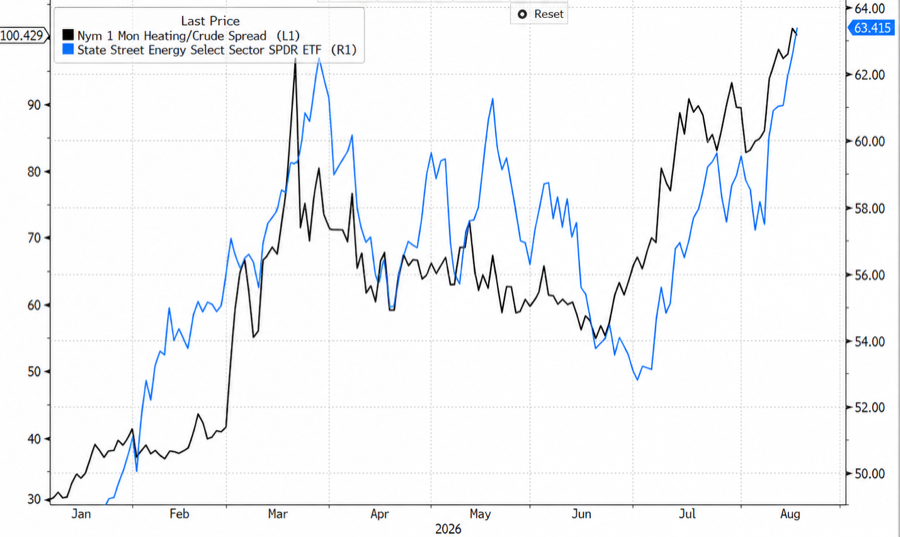
Looking at premarket movers away from the non stop newsflow, Mag 7 stocks are higher (Tesla +0.5%, Alphabet +0.6%, Amazon +1.8%, Meta +1.4%, Nvidia +2.1%, Microsoft +1%, Apple +1.6%). Energy stocks are falling and airline stocks are rising after Trump said he told US forces to postpone all strikes against Iranian power plants and energy infrastructure.

  • Apogee Therapeutics (APGE) soars 16% after the drug developer provided maintenance data from a mid-stage trial that showed its experimental therapy deepened responses in patients with moderate-to-severe atopic dermatitis.
  • DraftKings (DKNG) gains 8% and Flutter (FLUT) rises 8% after the Wall Street Journal reported that US senators are set to introduce bipartisan legislation to ban sports bets on prediction markets.
  • Synopsys (SNPS) gains 3% after people familiar said activist investor Elliott Investment Management has made a multibillion-dollar investment in the chip-design software maker and plans to push for changes.
  • Valvoline rises 2% after Stifel raised the recommendation to buy, saying a recent selloff has created a buying opportunity for the automotive services company as concerns about more expensive base oil and gasoline are largely priced into the stock.

In other news, BBG reported that Fannie Mae and Freddie Mac have begun placing sizable orders to purchase mortgage-backed securities. UBS Group AG Chief Executive Officer Sergio Ermotti said the Iran war could force him to pare back spending, although it won’t fundamentally alter the bank’s overall strategy. Owners of luxury brands ranging from Gucci to Fendi and Bulgari opened more stores in Europe last year despite a slowdown in the wider sector.

Trump’s comments sparked a sharp turnaround in markets after the two sides escalated rhetoric over the weekend, with hours left before a deadline for Iran to reopen the Strait of Hormuz. Rising oil prices have fueled fears that central banks may be forced to tighten monetary policy.

“Assuming this holds and there is a path toward a cessation of hostilities, we can expect stabilization in equities, panic liquidation, and crucially, an unwinding of some of the very aggressive rate hikes which have been priced into markets,” said Geoff Yu, senior macro strategist at BNY.

Since it is pointless to discuss where stocks are since moves are +/- 1-2% every minute, here is a quick recap of ...

  • Trump postponed threatened strikes against Iranian energy infrastructure and power plants for five days, pending the outcome of talks with Iran to end the war. Iran's semi-official local media denied any talks had taken place: BBG

  • The Trump administration is telling foreign officials and others that it will not reschedule a summit between the president and Chinese leader Xi Jinping until the Iran war ends. Politico

  • Donald Trump’s new tariff plans risk getting bogged down in protracted legal challenges as the president relies on obscure laws to wage his trade war after the top court in the US ruled many of his previous duties illegal. FT

  • The BoJ is laying the groundwork for tweaks to its policy language in April, keeping alive the chance of a near-term interest rate hike as the weak yen and Middle East conflict pile inflationary pressures on the economy.

  • Japanese companies have agreed to raise wages by more than 5% for a third consecutive year, early results from annual labor talks showed on Monday, reflecting sustained gains in pay that policymakers see as key to fostering durable economic growth. RTRS

  • A Cuban official said the country is preparing for a possible military assault as Trump increases the economic pressure on the country. BBG

  • LaGuardia Airport was closed until at least 2 p.m. after an Air Canada Express plane collided with a fire truck shortly after landing. Two pilots died in the crash. BBG

  • Truckers are being “crushed” by the surge in diesel expense, and US consumers will soon feel the increase as the whole supply chain is forced to adjust prices higher to maintain profitability. WSJ

  • Kevin Warsh is facing one of the most awkward Federal Reserve leadership transitions in decades. The economy has grown more complicated than when he promised interest-rate cuts last year while campaigning for President Trump to nominate him for the job. Even before the war in Iran sent energy prices higher, the Fed’s preferred inflation measure was heading in the wrong direction. The war threatens to push inflation higher still in the coming months, and investors now view rate increases to be more likely than cuts this year. WSJ

  • ARE WE OVERSOLD? That has been one of the most frequent questions this week – and there is not a ton of reassuring evidence just yet. A tactical bounce is clearly possible given recent price action, but the broader setup does not yet point to capitulation. Locally, only ~14% of S&P stocks have hit oversold levels. For context, that figure reached over 50% in April ’25 and north of 40% during Q3 ’22: Goldman

Tyler Durden Mon, 03/23/2026 - 12:45

Epstein Cover-Up Deepens; FBI Officers Raise Alarm

Zero Hedge -

Epstein Cover-Up Deepens; FBI Officers Raise Alarm

Authored by Steve Watson via Modernity.news,

Fresh Justice Department files reveal a frantic document destruction operation at the Metropolitan Correctional Center in Manhattan just days after Jeffrey Epstein’s 2019 death, adding fresh fuel to suspicions of elite protection and deep state obstruction.

This latest bombshell, drawn from a Miami Herald analysis of thousands of pages in the Epstein files, fits the pattern of irregularities we’ve exposed in our prior reporting.

Less than a week after Epstein was found dead inside his cell on August 10, 2019, an inmate was ordered to take bags of shredded material to the jail’s rear gate and throw them in a dumpster on Thursday, August 15, and again on Friday, August 16. The sheer volume struck him as unusual.

“They are shredding everything,” the inmate told one of the guards, adding that he was asked to give the officials a hand with the shredding, with key records vanishing before review.

A corrections officer at the detention facility called the FBI’s National Threat Operations Center that same night, a Friday, at 6:28 p.m. to report that he had “never seen this amount of bags of shredded documents coming out to be put in the dumpster at the rear gate of MCC.”

The caller found it suspicious that an after-action team charged with investigating would be shredding huge amounts of paperwork with FBI, BOP and OIG officials in the building.

A back gate corrections officer was also troubled by what he witnessed. In a memo to investigators three days later, on Monday, August 19, he wrote: “I believe that this conduct may be inappropriate for [an] investigative team to be shredding paperwork related to the investigation and you may want to investigate why BOP employees are destroying records.”

“Can we take a look at the Dumpster ASAP to see if the paper is still there? Possible they didn’t dump it yet,” replied one of the federal agents.

But it was already too late. The trash was picked up that very morning.

Federal prosecutors discovered something else amiss: “We learned today that all institutional count slips for dates prior to August 10, 2019, which we requested on August 12, 2019, are apparently ‘missing.’”

The U.S. Attorney’s Office for the Southern District of New York opened three separate probes: one into Epstein’s death, an obstruction-of-justice case involving the shredding of documents and possible misconduct by correctional officers, and a separate “Color of Law” corruption probe. Shockingly, these shifted from potential FBI criminal cases to the Justice Department’s Office of the Inspector General, which cannot prosecute.

Then-Attorney General William Barr immediately announced an “apparent suicide.” The medical examiner ruled the same, so Epstein’s cell was never treated as a crime scene. Critical evidence, including the fabric allegedly used in the hanging, was never properly examined.

Forensic pathologist Dr. Michael Baden, hired by Epstein’s estate and a veteran of over 20,000 autopsies, argued the neck injuries and ruptured capillaries in the eyes were more consistent with strangulation than suicide by hanging.

The Bureau of Prisons conducted a standard “After Action Review,” stating these teams “review such things as various background information for the inmate, health care and personality information, antecedent circumstances, and various other details surrounding the suicide. This team then draws conclusions and makes recommendations to the facility.”

Yet the rush to shred documents and the missing count slips tell a different story.

These developments expose the same bureaucratic stonewalling and selective transparency that has shielded powerful figures tied to Epstein’s network. While some claim simple incompetence, the coordinated destruction of records right under the noses of investigators screams intent to bury connections that could implicate elites.

Your support is crucial in helping us defeat mass censorship. Please consider donating via Locals or check out our unique merch. Follow us on X @ModernityNews.

Tyler Durden Mon, 03/23/2026 - 12:00

Amid Shortage Fears, ASP Isotopes Completes Drilling For Helium Project Ahead Of Schedule

Zero Hedge -

Amid Shortage Fears, ASP Isotopes Completes Drilling For Helium Project Ahead Of Schedule

Shortly after we posted a breakdown on the incoming helium supply disruption from Qatar for our premium subscribers, ASP Isotopes announced that they had completed the well drilling required for Phase 1 of the Renergen Helium Project approximately four months ahead of schedule. The achievement marks a key operational milestone at the Virginia Gas Project in South Africa, substantially reducing execution risks for the planned helium and LNG production ramp.

The stock spiked higher on the news...

Drilling operations, which restarted in April 2025 following bridge loan funding from ASP Isotopes ahead of the Renergen acquisition, have now achieved the required cumulative nameplate flow rate. Results from the Phase 1C exploration campaign show gas flow rates that meet or exceed previously estimated type curves. Some recent wells delivered flows up to 16 times higher than earlier ones, thanks to improved exploration techniques and reservoir modeling by a U.S.-based expert team.

"This marks a watershed moment for our plans for helium production at the Virginia Gas Project," said Paul Mann, Executive Chairman and CEO of ASP Isotopes. "This result, together with the cumulative flow data from the broader campaign, demonstrate that the field is capable of sustaining the gas volumes required to operate the helium plant at efficient capacity once wells are tied into the plant”.

Next steps include tying the new wells into the processing plant over the coming months. Once production-ready, total gas flow is expected to support Phase 1 nameplate capacity. Production will ramp in line with customer demand and offtake agreements, with discussions ongoing for LNG and liquid helium supplies. Phase 1 targets output of 2,500 GJ per day of LNG and 58 MCF per day of liquid helium upon completion in 2026.

As we’ve thoroughly tracked, this progress builds directly on the company's acquisition of Renergen. Following regulatory clearance reported here in December 2025, the deal integrated high-concentration helium assets into ASPI's portfolio of critical materials. Helium serves not only as a vital input for semiconductors, quantum computing, medical imaging, and space applications but also as a carrier gas in the company's proprietary isotope enrichment processes.

Readers will recall our earlier coverage of ASP Isotopes' Silicon-28 supply contracts and U.S. radiopharmacy acquisition in October 2025, the private placement backed by funds linked to Eric and Donald Trump Jr. in November, and more recent advances including a major nuclear operator MOU and progress toward commercial uranium enrichment. This latest update on the helium front further diversifies ASPI's exposure across nuclear fuel, medical isotopes, quantum materials, and now reliable helium supply amid global constraints, including disruptions tied to Qatar production.

Tyler Durden Mon, 03/23/2026 - 11:45

OpenAI Lures Private-Equity Firms With 17.5% Guaranteed Returns As AI Rivals Race For Enterprise Deals

Zero Hedge -

OpenAI Lures Private-Equity Firms With 17.5% Guaranteed Returns As AI Rivals Race For Enterprise Deals

OpenAI, the maker of ChatGPT, is offering private-equity firms a more generous financial package than rival Anthropic as the two artificial-intelligence companies court buyout shops to create joint ventures aimed at raising fresh capital and accelerating the rollout of enterprise AI products.

To lure PE firms, OpenAI is promising investors a guaranteed minimum return of 17.5%, a figure significantly above what is typical for preferred equity instruments, according to people familiar with the discussions who spoke with Reuters. The company is also providing early access to its latest AI models as it seeks commitments from firms including TPG Inc. and Advent International Corp., the people said. OpenAI has recently intensified its focus on corporate customers, an area where Anthropic has long held an edge.

Anthropic’s parallel effort offered no such guaranteed returns, the people said.

The timing of these overtures is notable. Just weeks ago, both companies became embroiled in a high-profile dispute with the Pentagon - with Anthropic walking away from a potential $200 million Defense Department contract after insisting on being the final arbiter over safeguards preventing its Claude AI from being used in fully autonomous weapons systems or mass surveillance of American citizens. The Pentagon responded by labeling Anthropic a “supply chain risk” - an unprecedented move against a U.S. technology company - blacklisting it from federal agencies and posing a risk to industry partners who also work with the Pentagon. President Trump directed all government entities to cease using Anthropic’s tools. The company has sued over this.

Hours after the deal fell apart on Feb 28, OpenAI announced its own agreement to supply AI tools for the Pentagon’s classified systems. The deal, initially criticized as opportunistic, triggered internal dissent at OpenAI, including the resignation of a senior robotics executive, and a consumer backlash that caused a surge in ChatGPT uninstalls among 'I bought this Tesla before Elon went crazy' types. OpenAI later amended the terms to strengthen guardrails.

And apparently there's no such thing as bad news, as Anthropic’s stance earned it a surge in popularity: Its Claude app climbed to the top of U.S. download charts, with sign-ups hitting record levels.

The Race Is On

The joint ventures would enable both companies to rapidly deploy customized AI across hundreds of established companies owned by private-equity firms, creating deep integration that boosts customer retention at scale.

“There’s a big race to lock in as much enterprise, as many desks as possible,” said Matt Kropp at Boston Consulting Group’s AI unit. “Once a customized AI model is integrated into a company’s systems, switching becomes much harder.

That said, some buyout firms have passed on the deals - citing concerns about economics, flexibility, and profit. Thoma Bravo LP opted out after internal reviews, with Managing Partner Orlando Bravo questioning the long-term profit profile, people familiar said. 

Skeptics argue large PE firms already have direct access to the AI providers and question whether the ventures deliver enough incremental value. Others see pressure on buyout shops to showcase AI strategies to their own investors.

Still, discussions continue with several firms expected to take smaller stakes. OpenAI is in advanced talks to raise about $4 billion for its venture at a roughly $10 billion pre-money valuation, with participants including TBG, Bain Capital and Brookfield Asset Management. Anthropic has approached Blackstone, Hellman & Friedman and Permira for its enterprise-focused push.

Tyler Durden Mon, 03/23/2026 - 11:25

Key Events This Week: PMIs, Productivity And Consumer Sentiment

Zero Hedge -

Key Events This Week: PMIs, Productivity And Consumer Sentiment

As has become customary for Monday, we have seen a dramatic surge in risk assets (3rd Monday in a row) on what at least superficially appears to be de-escalation after Trump announced strikes against Iran's power plant would be delayed by 5 days as a result of talks with Iran, talks which at least Iran's domestic news sources have so far denied.

And the market lurches from headline to headline, it feels somewhat trivial to focus on the week ahead data calendar, but there will nevertheless be interest in the global flash PMIs for March, due tomorrow. As DB's Jim Reid notes, these surveys cover the period through roughly the end of last week and should therefore be heavily influenced by developments in the conflict. Elsewhere, inflation indicators are due in the UK, Japan and Australia, although these will now be quite backward looking. The German IFO survey on Wednesday may provide another timely read on sentiment, and Lagarde’s speech the same day will also be closely watched. The week concludes with the final March reading of the University of Michigan US consumer sentiment survey, which incorporates an additional couple of weeks of responses from the initial reading. DB's economists expect a modest downward revision to 55.0 from the preliminary 55.5 as more respondents reflect heightened geopolitical uncertainty related to Iran. More important for policymakers, however, will be the inflation expectations components. Both one year and five to ten year expectations have historically tracked energy prices closely, making them particularly relevant in the current environment.

Overall the data calendar is light in the US, and even if it were busier it would likely pale in significance relative to events in the Middle East. On the policy front, scheduled Fed appearances are limited, with only three officials due to speak. The first comes from Vice Chair Jefferson, who is set to deliver an outlook speech on Thursday. He is likely to broadly echo the themes laid out by Chair Powell at the post meeting press conference, where Powell placed greater emphasis on inflation dynamics and the outlook than on potential labor market weakness, giving the discussion a distinctly hawkish tone. Inflation, rather than employment, clearly remains the Fed’s primary concern at this stage of the cycle.

Any divergence by Jefferson from Powell’s messaging would more likely be aimed at tempering expectations of imminent tightening rather than endorsing them, particularly given the sharp repricing from roughly 62bps of cuts before the strikes on Iran to around 7bps of hikes this morning (although that number has also reversed after this morning's newsflow). The same logic applies to remarks expected on Friday from San Francisco Fed President Daly and Philadelphia Fed President Paulson, both of whom are non voters this year and are also scheduled to deliver outlook speeches. In markets where incoming data is increasingly backward looking, there is limited value in dwelling on the remainder of the week ahead calendar, which is set out day by day at the end as usual.

Courtesy of DB, here is a day-by-day calendar of events

Monday March 23

  • Data: US February Chicago Fed national activity index, January construction spending, Japan first survey of shunto results, Eurozone March consumer confidence
  • Central banks: ECB's Escriva and Lane speak
  • Other: UK PM Starmer faces the House of Commons’ Liaison committee

Tuesday March 24

  • Data: US, UK, Japan, Germany, France and the Eurozone flash March PMIs, US March Philadelphia Fed non-manufacturing activity, Richmond Fed manufacturing index, business conditions, Japan February national CPI, EU27 February new car registrations, 
  • Central banks: ECB's Kocher, Sleijpen, Cipollone and Lane speak
  • Auctions: US 2-yr Notes ($69bn)
  • Other: General election in Denmark

Wednesday March 25

  • Data: US February import price index, export price index, Q4 current account balance, UK February CPI, RPI, PPI, January house price index, Japan February PPI services, Germany March Ifo survey, Australia February CPI
  • Central banks: ECB's Lagarde, Lane, Rehn and Kocher speak, BoE's Greene speaks, BoJ minutes of the January meeting
  • Earnings: Jefferies, PDD Holdings 
  • Auctions: US 2-yr FRN (reopening, $28bn), 5-yr Notes ($70bn)

Thursday March 26

  • Data: US March Kansas City Fed manufacturing activity, initial jobless claims, Germany April GfK consumer confidence, France March business confidence, consumer confidence, Italy March consumer confidence index, economic sentiment, manufacturing confidence, Eurozone February M3
  • Central banks: Norges Bank decision, Fed's Jefferson speaks, ECB's Guindos and Muller speak, BoE's Breeden, Taylor and Greene speak, BoC’s Rogers speaks
  • Earnings: Meituan
  • Auctions: US 7-yr Notes ($44bn)
  • Other: G7 foreign ministers meeting (through Friday)

Friday March 27

  • Data: US March Kansas City Fed services activity, UK March GfK consumer confidence, February retail sales, China February industrial profits
  • Central banks: ECB consumer expectations survey, Fed’s Daly and Paulson speak
  • Earnings: Carnival, BYD

Finally, looking at just the US, Goldman writes that the key economic data releases this week are the productivity and costs report on Tuesday and the University of Michigan report on Friday. There are several speaking engagements by Fed officials this week, including events with Governors Miran, Barr, and Cook, and Vice Chair Jefferson. 

Monday, March 23 

  • 08:45 AM Fed Governor Miran speaks: Fed Governor Stephen Miran will appear on Bloomberg TV. On February 26, Miran said, "Four cuts [in 2026] I think are appropriate. I’d rather get them sooner than later." Additionally, on March 6, Miran said, "Labor demand is not strong enough because monetary policy is too tight… I think the labor market could use some more support from monetary policy." 
  • 10:00 AM Construction spending, January (GS +0.3%, consensus +0.1%, last +0.3%) 

Tuesday, March 24 

  • 08:30 AM Nonfarm productivity, Q4 final (GS +1.7%, consensus +1.8%, last +2.8%); Unit labor costs, Q4 final (GS +4.3%, consensus +3.4%, last +2.8%): We estimate that nonfarm productivity growth will be revised down by 1.1pp to +1.7% quarterly annualized in the second release for 2025Q4. Since 2019Q4, labor productivity has grown at an annualized rate of 2.2%, or 2.0-2.1% after adjusting for measurement distortions in the productivity statistics, a much stronger pace than the 1.5% average pace in the pre-pandemic cycle.
  • 09:45 AM S&P Global US manufacturing PMI, March preliminary (consensus 51.2, last 51.6): S&P Global US services PMI, March preliminary (consensus 52.0, last 51.7)
  • 06:30 PM Fed Governor Barr speaks: Fed Governor Michael Barr will speak on the economic outlook and community development at the National Community Investment Conference in Phoenix. Speech text is expected. On February 17, Barr said, "Based on current conditions and the data in hand, it will likely be appropriate to hold rates steady for some time." He also said, "With very low levels of job creation and also a low firing rate, there seems to be a tentative balance in labor supply and demand. But it is a delicate balance, and that means that the labor market could be especially vulnerable to negative shocks."

Wednesday, March 25 

  • 08:30 AM Import price index, February (consensus +0.6%, last +0.2%); Export price index, February (consensus +0.6%, last +0.6%)
  • 04:10 PM Fed Governor Miran speaks: Fed Governor Stephen Miran will participate in a conversation on digital assets at the 2026 Digital Asset Summit in New York. 

Thursday, March 26 

  • 08:30 AM Initial jobless claims, week ended March 21 (GS 205k, consensus 210k, last 205k); Continuing jobless claims, week ended March 14 (consensus 1,853k, last 1,857k): We estimate that initial jobless claims were unchanged around 205k. Initial claims remain below their average level in 2025H2 and the layoff rate edged down in January, suggesting that nationwide layoffs remain low despite the increase in alternative layoff measures in Q4 of last year.
  • 04:00 PM Fed Governor Cook speaks: Fed Governor Lisa Cook will speak on financial stability at the Yale School of Management. Speech text and Q&A are expected. On February 4, Cook said, "[Recent] readings indicate that progress on inflation essentially stalled in 2025… After nearly five years of above-target inflation, it is essential that we maintain our credibility by returning to a disinflationary path and achieving our target in the relatively near future." She also said, "The labor market is roughly in balance, but I am highly attentive to developments, knowing it can shift quickly."
  • 06:30 PM Fed Governor Miran speaks: Fed Governor Stephen Miran will speak on the Fed's balance sheet at the Economic Club of Miami. Speech text and Q&A are expected. 
  • 07:00 PM Fed Vice Chair Jefferson speaks: Fed Vice Chair Philip Jefferson will speak at the Dallas Fed. On February 6, Jefferson said "I am cautiously optimistic about the economic outlook. I see signs suggesting that the labor market is stabilizing, that inflation can return to a path toward our 2% objective, and that sustainable economic growth will continue." 
  • 07:10 PM Fed Governor Barr speaks: Fed Governor Michael Barr will participate in an event at the Brookings Institution. Speech text and Q&A are expected. 

Friday, March 27 

  • 10:00 AM University of Michigan consumer sentiment, March final (GS 52.0, consensus 54.0, last 55.5):  University of Michigan 5-10-year inflation expectations, March final (GS 3.5%, last 3.2%)
  • 11:30 AM San Francisco Fed President Daly (FOMC non-voter) speaks: San Francisco Fed president Mary Daly will give introductory remarks at the San Francisco Fed's Macroeconomics and Monetary Policy Conference. On March 6, Daly said, "We really have to keep our eye on the labor market. But we also have inflation printing above our target and oil prices rising. How long it will last we don’t know. But both our goals are at risk now and we have to keep our eye on both."
  • 11:40 AM Philadelphia Fed President Paulson (FOMC voter) speaks: Philadelphia Fed president Anna Paulson will give remarks at the San Francisco Fed's Macroeconomics and Monetary Policy Conference.

Source: DB, Goldman

Tyler Durden Mon, 03/23/2026 - 11:15

"The Numbers Are Shocking": California Faces Scrutiny Over Hospice Fraud

Zero Hedge -

"The Numbers Are Shocking": California Faces Scrutiny Over Hospice Fraud

Authored by Tom Gantert via The Epoch Times,

Dr. Mehmet Oz, administrator of the Centers for Medicare and Medicaid Services, posted an Instagram video this week detailing ongoing fraud among hospice and health care facilities in Los Angeles County.

Investigations have focused on Los Angeles County, where officials said state regulators did little to stop fraud. 

Investigators believe that the start of the hospice fraud can be traced as far back as 2010.

“The normalization of hospice fraud in California has to stop,” Oz said in his Instagram video while standing in front of one of the Los Angeles County homes that served as a hospice. “The numbers are shocking.”

Here’s what to know about the ongoing fraud scandal and how it is being addressed.

How Do Hospice Schemes Work?

Oz described in his video how the people running that particular hospice allegedly enrolled six individuals into their program.

The patients in the facility allegedly weren’t dying but were put on hospice so the owners of the business could charge Medicare for providing care. The owners also shared their patients’ information with other hospice centers that were in on the scam so they could get paid, Oz said. 

Government investigations into Los Angeles County’s operations showed that some hospice agencies might be using stolen identities of medical personnel and that many of the so-called terminal patients were living well beyond expectations. 

Investigators believe that the hospices are enrolling patients who are not suffering from terminal illnesses because the patients were found to have “unusually long” stays at the facilities, and high rates of patients were discharged alive. 

The financial incentives for fraud are significant. A California state auditor report states that a hospice agency that bills for 20 patients at the going rate can make $122,000 per month. 

In 2023, the Centers for Medicaid and Medicare Services estimated that improper payments in home health claims totaled $1.2 billion.

‘People Aren’t Paying Attention’

Investigators said the growth in Los Angeles County hospices began in 2010.

There were 109 hospice agencies in Los Angeles County serving 1 million elderly people in 2010. By 2021, there were 1,841 hospice agencies serving 1.4 million elderly people. From January 2019 to August 2021, the state received 2,600 applications for hospice agencies in Los Angeles County.

According to one government investigation, a single building with 22,500 square feet of space in the community of Van Nuys contained more than 150 licensed hospice and home health agencies—a number investigators believe exceeded the structure’s capacity. The building had no signage indicating that it was housing so many hospices. 

Oz said Los Angeles County accounts for about one-third of all hospices in the United States. Of the 2,836 hospices in California, 1,841 were located in Los Angeles County, or nearly two out of every three hospices.

“That only happens because people aren’t paying attention,” Oz said in his Instagram video.

Lack of Oversight

In March 2022, the state auditor warned that the state’s “weak” oversight of the hospice and health care business has “created the opportunity for large-scale fraud and abuse.” 

The Centers for Medicare and Medicaid Services directed the California Department of Public Health, the state agency responsible for licensing and oversight, to investigate the single Van Nuys building that was found to have 150 licensed hospice and home health agencies.

The Van Nuys hospice agency door was locked, and the office phone was not working when investigators showed up in January 2021, according to a state audit report. The California Department of Public Health had to contact the building’s landlord to get the owner’s contact information. The owner didn’t show up for scheduled meetings with Public Health for three days, and Public Health was unable to obtain any records. The owner was not able to answer questions regarding the agency, and when asked about her title, she told investigators, “We have not decided yet.”

The California Department of Public Health stated that it couldn’t substantiate any fraudulent activities and closed the investigation without taking any action. 

The state auditor also discovered that Public Health became aware of possible fraud during the licensing process but still granted licenses to those hospice agencies. Public Health has not suspended a single hospice license since 2015 and revoked only one license, the auditor said. 

Public Health was also taking five months to complete its investigations of patient abuse, which investigators considered “near the upper limit” of a hospice patient’s expected life span. 

The auditor’s report states that Public Health agreed with most of the recommendations but stated that some might require legislation to be passed.

The California Department of Public Health didn’t respond to an email seeking comment from The Epoch Times.

Attempts at Reform

Politicians have attempted to address the fraud with legislation, litigation, and other actions.

California Gov. Gavin Newsom signed a law on Oct. 4, 2021, that stopped all new hospice licenses due to fraud concerns. The ban was extended through January 2027. 

In November 2025, the Department of Justice reported that its fraud division had charged more than 5,800 defendants nationwide involved in health care fraud since 2007. Those 5,800 defendants billed federal health care programs and private insurers for more than $30 billion.

On Jan. 27, Newsom said the California Department of Public Health had revoked more than 280 hospice licenses in the past two years and had identified about 300 more hospices to be evaluated for potential revocation of their licenses.

Since 2021, the California Department of Justice has investigated 101 criminal enterprises and 284 criminal defendants and filed 24 civil cases. As of January, 109 individuals have been charged with hospice-related offenses.

At the federal level, Congress is looking into the issue. A March 17 hearing in the House addressed fraud in hospices across the country.

Rep. Linda Sanchez (D-Calif.) and Sen. Mark Warner (D-Va.) introduced a bill that aims to protect hospice patients and taxpayers from fraud.

At the state level, California Assemblywoman Alexandra Macedo, a Republican representing a rural San Joaquin Valley district, sent a letter on March 16 to the Subcommittee on Health criticizing the Newsom administration for not doing enough to stop the fraud.

Macedo said in the letter that she visited a dilapidated building in Van Nuys that had 197 hospice agencies registered to that address.

She said that Newsom’s administration has “failed to provide the aggressive oversight necessary to stop this hemorrhaging of public funds.”

“Despite a state audit and supposed moratorium on new licenses, these fraudulent hubs continue to operate in broad daylight,” Macedo said.

In January, Newsom said that the Trump administration has “dismantled the federal government’s ability to prevent and address fraud.”

“California didn’t wait—we’ve identified and cracked down on hospice fraud for years, taking real action to protect patients and taxpayers,” Newsom said in a statement.

The National Partnership for Healthcare and Hospice Innovation (NPHI) stated that it is involved with federal leaders to find solutions. The NPHI stated that the fraud issues are not “representative of the majority of hospice providers, who are focused every day on delivering high-quality, compassionate care to patients and families.”

“NPHI is actively working with the Administration and CMS to identify ways to target and root out bad actors,” said Tom Koutsoumpas, founder and CEO of NPHI. “We are encouraged to see decisive steps being taken to crack down on fraud and remove these bad actors from the hospice system, while safeguarding the integrity of hospice care for patients and families nationwide.”

Tyler Durden Mon, 03/23/2026 - 11:05

Iran Phones Russia Immediately On Heels Of Trump's Announcement Of US-Iran Talks

Zero Hedge -

Iran Phones Russia Immediately On Heels Of Trump's Announcement Of US-Iran Talks

Iranian Foreign Minister Abbas Araghchi held talks with Sergei Lavrov quickly on the heels of President Trump early Monday having claimed Washington and Tehran had "very good and productive conversations regarding a complete and total resolution of our hostilities" - as the war is in its fourth week.

Moscow appears to be moving to position itself as a broker, with Russia's foreign ministry announcing that FM Lavrov called for an "immediate cessation of hostilities and a political settlement that takes into account the legitimate interests of all parties involved, above all Iran," in a call initiated by Tehran.

AFP/Getty Images

The Kremlin followed this by its spokesman Dmitry Peskov stating negotiations should have begun "yesterday" - adding that "this is the only way to effectively ease the catastrophically tense situation in the region."

Trump had on Saturday unveiled a time-specific ultimatum which threatened to "obliterate" Iranian power plants if Tehran refuses to reopen the Strait of Hormuz. The clock is ticking on the 48-hour timeline, and it's unclear how the Trump-touted Tehran-Washington contacts will impact that (contacts which Tehran has denied).

As for the Kremlin, Peskov also warned against strikes on nuclear infrastructure following reported attacks on Natanz nuclear facility, stating: "We believe that strikes on nuclear facilities are potentially extremely dangerous … Therefore, the Russian side, taking an extremely responsible stance on this issue, has repeatedly voiced its concerns."

The risk is no longer theoretical given that Russia's state nuclear firm Rosatom and the International Atomic Energy Agency had confirmed a projectile strike on the Bushehr Nuclear Power Plant, marking a dangerous new phase where nuclear sites are no longer off limits.

This in turn resulted in Iran for the first time targeting Dimona, home to Israel's major nuclear reactor and research complex. But there's no indication it suffered any direct hits.

"Dimona, where the second missile hit, is perilously close to Israel’s main nuclear reactor and research site. Iranian state media said the strike targeted the nuclear facility in retaliation for an attack on an Iranian nuclear enrichment site at Natanz, though the IDF has said it was unaware of that operation," NBC reports.

"The International Atomic Energy Agency said that no abnormal off-site radiation levels had been observed following the strikes, though it urged all sides to exercise restraint near nuclear sites," the report added.

At this point it's anything but clear whether Trump's announcement of talks will lead to an actual slowdown or pause in fighting. Here's how Russia's RT framed Iran's stance:

Iranian sources, however, have told state media that no negotiations have been held with Washington, even through intermediaries. The Iranian Embassy in Afghanistan has stated that Trump “backed down” after Iran’s “firm warning” that it would retaliate to strikes on its energy infrastructure by attacking power plants across the region.

On Sunday US Treasury Secretary Scott Bessent told "Meet the Press" that Washington must "escalate to de-escalate" in the Iran and Strait of Hormuz situation. However, Washington never seems to be able get to the "de-escalate" part.

Tyler Durden Mon, 03/23/2026 - 09:00

Gold's Biggest Fire-Sale In 43 Years: Perception Vs Opportunity

Zero Hedge -

Gold's Biggest Fire-Sale In 43 Years: Perception Vs Opportunity

Authored by Matthew Piepenburg via VonGreyerz.gold,

If you are new to gold, or if you are a speculator in gold (or even worse, a levered speculator in gold), you are likely asking yourselves what in the “H. E. double tooth-picks” just happened to gold?

It lost over 9% in the futures market in a single session and saw its worst week of price declines since February 1983.

What gives? Gold loves chaos, and isn’t the current war, whatever you think of it, pure chaos?

And what about gold-loving oil shocks, as we and others have often written and spoken?

And what about gold as an anti-inflation asset?

Shouldn’t gold be ripping north in a world careening under the weight of oil-driven “everything” and “everywhere” inflation?

All fair questions to say the least.

But if, like us, you hold physical gold (that rising, strategic Tier-1 reserve asset) as a superior store of value over any paper currency system, including King Dollar, then the facts below will seem far less like an “apology” for the metal’s longer-term horizon.

Physical Gold: Accumulating, Not Falling

Instead, a little bit of perspective confirms that PHYSICAL gold is not falling, it’s openly accumulating by bigger players enjoying the mother of all “Fire Sale” signals from the paper gold markets.

The insider whales, of course, are exploiting this opportunity while the headlines are shaking out the retail minnows. This is a classic and inevitable pattern, of which I recently warned.

In short, there is an extraordinary and deliberate perception game in play right now, and many misinformed investors might be falling for it as paper gold currently falls in price.

But this fall is strategic and not random.

It reflects a set-up for rising physical gold rather than a confirmation of some typical blow-off top, as there is nothing typical about gold or its future monetary role in a monetary system in open decline, regardless of the DXY’s recent headlines.

To better understand this, one needs to separate paper gold from physical gold. Their divergence is key.

One must also separate gold’s long-term preservation role (and investors) from gold’s short-term speculation game (and traders). They are not the same.

Most importantly, one needs to separate current headlines (and misperception) from longer-term historical cycles.

As said elsewhere, sophisticated gold investors, like hockey players, play the direction of the golden puck, not where it sits at any given moment (high or low).

And gold’s longer direction north is ironically clearer now than before.

But to better see gold’s secular direction north rather than its present position, we need to first understand how it got to this current price fall.

How We Got Here? The Official Narrative

In fact, for once, the official narrative out of Wall Street is at least partly correct.

It essentially argues that the war and oil-driven inflation is now so obvious that the Fed will have no choice but to once again raise rates to fight it. The ECB has already confessed as much for the Euro.

Rising rates, and hence a high-risk premium (and yields) for USTs, mean the dollar (and DXY) will go higher as institutional and retail money flows toward a higher-yielding bond and a rising dollar rather than a yield-less and falling gold.

This is not altogether untrue.

Until war made the headlines, the Fed was not only expected to pause any further rate hikes, but to, in fact, cut rates into 2026, which would have been a tailwind for gold.

According to the headlines, however, the winds of this war have turned gold’s tailwinds into headwinds.

In fact, this is hardly the end of the story. Not even close.

For those whose memory can stretch as far back as 2022 and 2023 when Powell’s “higher-for-longer” rate hikes were allegedly aimed to fight inflation, we discovered that such “anti-inflationary” tactics were actually, and ironically, just inherently inflationary and ultimately a tailwind for gold’s subsequent move higher into 2024 and 2025.

Then as now, rate hikes to fight inflation just make Uncle Sam’s interest expense on his $39T bar tab all the more expensive and unpayable unless he prints trillions in more synthetic (and inflationary) liquidity, a paradox (and debt trap) the fancy lads call Fiscal Dominance. And even the St. Louis Fed has confessed that the USA is indeed “dominated” by it.

Soon both inflation and rates will spike beyond the control of the Fed, and the only trick left up its tattered sleeves to save its bond markets (which is the only real mandate the Fed truly follows), will be mouse-clicked trillions to the moon.

The currency destruction that follows will send gold north as paper currencies, including the USD, get yet another reckoning of epic debasement.

Right now, of course, few see this reckoning. All they see is the paper gold price falling.

But such headlines (and errors) are only part of a larger story, one which far better explains the realities behind the current position of the golden puck.

How We Got Here? The Real Narrative

Gold, like life, markets and history itself, has a fascinating symmetry to it. And as Mark Twain famously remarked, history has a way of rhyming if not otherwise repeating itself.

Reason 1: The OPEC Selloff

As to last week’s paper gold fall, it rhymes a heck of a lot with its similar fall in 1983.

Then, as now, gold was falling due to a massive OPEC sell-off in the metal. But the trigger for the current OPEC sell-off in gold is being pulled for an entirely different reason than in 1983.

In 1983, for example, oil around the world was at a massive surplus. Its price was thus tanking. As a result, the OPEC nations needed immediate liquidity to meet their dollar pegs. So, what did they do?

They sold a lot of gold, and thus gold’s price fell dramatically.

But in the current chaos of yet another war in a key oil region, oil is not falling, it’s ripping north, with major banks predicting oil prices as potentially high as $180 a barrel.

Clearly, in such a setting, OPEC has no need for cash, right?

Wrong.

The Strait of Hormuz, where 1/5 of global oil moves, is literally clogged.

This means all that expensive oil can’t flow. And if it can’t flow, it can’t be sold. And if it can’t be sold, the OPEC players in that region can’t get paid. And if they can’t get paid, they need to sell assets from their piggy banks.

And that asset is gold. (Saudi’s gold piggy bank is around 300 tons. Qatar’s is over 100 tons.)

This makes our particular war uniquely hard on gold—but only for the near-term.

Regardless of the current headlines (and mis-narrative), the desire by central banks (and a de-dollarizing BRICS+ coalition) to replace USTs and paper currencies with physical gold will not change.

Thanks to Trump and Netanyahu, these bigger players just get to accumulate that gold at a literal fire sale rather than rising price.

Needless to say, those playing the longer direction of the golden puck’s price move (including Asia and China) are more than happy to buy this Tier-1 asset at the current discount, and that’s precisely what the big boys (and U.S. banks) will do.

As usual, however, the little boys (i.e., the uninitiated who saw gold as a get-rich-quick paper trade) are doing just the opposite. They are selling paper gold claims as the insiders are buying the physical metal. Retail investors are reacting to headlines rather than history, flows, pending QE spikes or longer-term investment horizons.

Reason 2: Whales Eating Minnows

As anyone who has spent their career in markets of any sector (from tech stocks to hard assets) already knows, most retail investors buy at price highs and get spooked out of bull cycles by the market whales throughout the ride up.

During 2025’s epic gold moves north, retail investors piled into the metal to speculate in the paper markets rather than hold physical gold as a preservation asset.

This seductive gamble came in the form of over $70B of flows into gold ETFs. And not just ordinary gold ETFs, but the kind that are levered 2X to 3X.

When gold is rising, such get-rich-quick speculators look like geniuses.

But when gold is falling, those levered positions (thanks to daily ETF rebalancing to cover levered margin calls) can be extremely humbling.

In short, those who live by the leverage sword almost always die by it.

The recent unwinding of levered ETF paper claims created the misperception that gold was falling in price, but this was just derivative paper pricing, not a true valuation metric to the price of physical gold, whose longer-term direction and valuation (as well as Shanghai premiums) are only in the first chapters of a much longer book.

The massive sell-off in levered ETF paper claims was just another buy-signal for the bigger banks, sovereigns and longer-term players looking to acquire the physical metal at a conveniently engineered paper price fall.

As we already know from the COMEX games played by the big banks, such engineered opportunities are Wall Street’s rules of engagement.

What we are seeing now is just whales buying discounted gold from terrified retail minnows.

That’s history repeating itself (rather than rhyming).

Shakeouts in bull markets are standard operating procedures. As warned just over a month ago, during gold’s massive bull market from 1971 to 1980, the metal got crushed in 1975-76 midway through its otherwise historical rise.

We Only Play the Long Game

In addition to the forces at play above, there are other short-term signals which explain the current paper gold slide.

This includes the endless array of robots rather than humans who do the bulk of the shadow-banking swing trades to justify short-term profit-taking.

When the robo-traders see a support line piercing, they follow the signals without emotion and sell the metals in concert. We saw this with gold in the spring of 2022 and the summer of 2023.

These endless regiments and brigades of robotic traders at hedge-funds A-Z don’t give a hoot about gold’s longer-term or future role as an evolving global strategic reserve asset any more than they understand gold’s historically undeniable role as a wealth preservation asset.

Algos think in terms of seconds, not years or cycles.

But as informed investors who know that precious metals hold their purchasing power infinitely better than paper currencies and IOUs, we respect gold’s past history as well as future cyclical direction.

For this reason, we were never gloating when gold hit its most recent all-time highs; nor were we wringing our hands when gold saw headline price falls.

For us, measuring physical metals in paper currencies or paper markets entirely misses the point, and critical understanding, of physical gold as real rather than melting (paper) money, and as a preservation rather than speculation asset.

Of course, most will say this is just our bias.

Fair enough.

But watch the BIS, the Fed, the TBTF banks and just about every other central bank in the world who have been stacking physical gold at 5X their pre-2022 levels for one simple reason: Rock beats paper.

What we are seeing in the current gold headlines is a buy signal, not a panic signal.

Tyler Durden Mon, 03/23/2026 - 08:05

Musk Plans To Appeal After Jury Finds Him Liable To Twitter Shareholders

Zero Hedge -

Musk Plans To Appeal After Jury Finds Him Liable To Twitter Shareholders

Authored by Aldgra Fredly via The Epoch Times (emphasis ours),

A federal jury on March 20 found tech billionaire Elon Musk liable for misleading Twitter shareholders by driving down the social media platform’s stock price months before acquiring it for $44 billion in 2022.

The decision follows a civil class action lawsuit filed by Twitter investors in October 2022. Musk agreed to buy Twitter at $54.20 per share in April 2022 but later tried to back out of the deal, leading the company to take legal action to enforce it. He ultimately completed the acquisition in October 2022 and rebranded Twitter to X.

The shareholders alleged that Musk made misleading statements after agreeing to buy Twitter in April 2022, leading them to sell their shares. They alleged that he published the statements to drive down Twitter stock prices in a bid to renegotiate the deal.

In a verdict on March 20, jurors found Musk liable for misleading investors through two social media posts. The first post said the deal was “temporarily on hold” pending verification that bots accounted for less than 5 percent of users on the social media platform.

In the second post, Musk suggested the percentage of bots could exceed 20 percent and said the buyout of Twitter could not ​go forward until he received confirmation that it was less ⁠than 5 percent.

However, the jury found that the plaintiffs failed to substantiate claims that Musk had engaged in a scheme to defraud investors.

The plaintiffs’ attorney, Mark Molumphy, called the verdict an “important victory” for both Twitter investors and the public markets.

I think the jury’s verdict sends a strong message that just because you’re a rich and powerful person, you still have to obey the law, and no man is above the law,” Molumphy told The Associated Press.

Musk’s legal team at Quinn Emanuel Urquhart & Sullivan said in a statement to multiple news outlets that they plan to appeal the verdict.

We view today’s verdict, where the jury found both for and against the plaintiffs and found no fraud scheme, as a bump in the road. And we look forward to vindication on appeal,” his legal counsel said.

Musk also faces a lawsuit from the Securities and Exchange Commission (SEC), which alleged that he violated federal securities laws by delaying disclosure of his acquisition of Twitter stock in March 2022, before making an offer to buy the company.

The SEC said the delay had allowed Musk to buy more shares at lower prices, allowing him to “underpay by at least $150 million for shares he purchased after his beneficial ownership report was due,” according to the January 2025 filing. Musk has sought dismissal of the suit.

The Associated Press contributed to this report.

Tyler Durden Mon, 03/23/2026 - 07:45

10 Monday AM Reads

The Big Picture -

My California morning reads:

AI and the Fable of the ATMs: Contrary to the usual story, ATMs did reduce teller demand. (Paul Kedrosky)

Jamie Dimon Sees an End on the Horizon. But Not Yet. After two decades, JPMorgan Chase’s CEO says he has three or four more years on the job, or maybe more. But even he’s talking about what comes next for himself and the bank. (Barron’s) see also Warren Buffett’s Sage Advice About Fear and Greed Is a Trap in This Market: The reflexive “be greedy when others are fearful” crowd may be walking into a trap—this isn’t a garden-variety selloff, and the Oracle’s maxim needs more nuance right now. (Marketwatch)

• Things I Wish I’d Known Before Buying an EV: A practical reality check on EV ownership—charging logistics, repair headaches, and other things the marketing brochures conveniently leave out. Rising oil prices have more people thinking about going electric, but it’s worth considering potential challenges with repairs, charging and other factors. (Wall Street Journal)

Why So Many Americans Online Suddenly Want to Become Chinese: “Chinamaxxing” is the latest absurdist internet meme that reveals just how disillusioned younger generations are. (Slate)

What are the biggest price determinants for watches? Hard-to-find modern luxury watches and high-quality historical collector’s items continue to fetch exceptionally high prices on the secondary market in 2026. Four and five-figure sums for rare vintage watches are not uncommon. (Chrono24 Magazine)

• Apple Is Way Behind in AI—and Still Making a Fortune From It Apple’s artificial-intelligence revenue is set to top $1 billion this year, reassuring investors. Its artificial-intelligence revenue is set to top $1 billion this year, reassuring investors wary of rivals’ sky-high spending (Wall Street Journal)

Thousands have swooned over this MAGA dream girl. She’s made with AI. A viral fake of an Army service member spotlights a new trend in online attention harvesting: part patriotism, part porn and 100 percent computer-made. (Washington Post)

In Favor of Enjoying Things on Purpose: Even though we are born enjoyment-mongers, we tend to overlook the greatest and most reliable source of enjoyment, which is our ability to consciously enjoy the stuff that happens anyway. We barely even talk about it. A case for deliberate pleasure—paying attention to what you’re eating, listening to, or watching instead of letting everything blur into background noise. (Raptitude)

• Who Am I When I Care? Emotion Through the Lens of Franz Boas. Does culture make emotion? Boas helps solve the puzzle of where our emotional lives actually originate: in our selves or in the cultures around us (Aeon)

• How Scientists Unlocked the Secret of a $400 Skin Cream: There’s a room in an Estée Lauder-owned facility on Long Island where kelp swirls around in giant kettles while scientists pump sounds of the ocean. Playing Music to Kelp. La Mer claims the magic of its bestselling products happens in a lab where chemists brew–and DJ for–the ‘Miracle Broth.’ (Wall Street Journal)

Be sure to check out our Masters in Business interview  this weekend with Bill Miller IV, Chief Investment Officer and Portfolio Manager at Miller Value Fund. Previously, he was at Legg Mason Capital Management covering specialty finance + consumer spaces with a focus on high-yielding securities. Miller competed in the Poker World Series Main Event. He began his career working for his father, famed investor Bill Miller III.


Huge Reversal of Senate Control Odds Since Iran War Began

Source: Adam Ozimek.


Sign up for our reads-only mailing list here.


The post 10 Monday AM Reads appeared first on The Big Picture.

European Court Denies Appeal Of Parents Seeking Custody Over Their Kids In Religious Freedom Case

Zero Hedge -

European Court Denies Appeal Of Parents Seeking Custody Over Their Kids In Religious Freedom Case

Authored by Jonathan Turley,

In Sweden, a Christian couple is going through a nightmare that captures the growing bias and targeting of religious families in Europe. Daniel and Bianca Samson have been fighting to regain custody of their daughters since 2022 after the government cited their regular church attendance and faith as warranting their removal.

The parents, with the help of the Alliance Defending Freedom International, were delivered another blow after the European Court of Human Rights refused to accept their appeal as “inadmissible.”

This saga began when their eldest daughter had a fight with her parents over being denied a smartphone and makeup.

She contacted police and made a false report of abuse.

However, Sara, quickly retracted the allegation and police found no evidence of abuse.

Nevertheless, the state took both girls — aged 10 and 11 at the time –and refused to allow them to return home.

The government alleged that they found evidence of “religious extremism” and, according to ADF, cited the family’s habit of attending church three times a week.

It also cited strict religious upbringing in the home.

In the United States, the findings would be glaring violations of the free exercise clause of the First Amendment. In Sweden, it is a viable basis for taking away your children.

So these girls want to go home and the parents want to restore their family.

The Swedish government and courts refuse to allow it.

They are still separated after the parents successfully completed state-mandated parenting courses.

They also were denied requests to move the girls into foster homes in Romania, where they live.

The Swedish Supreme Court refused to hear the case last year, but the European Court of Human Rights said that they had failed “to exhaust legal remedies in Sweden.”

Now, according to the ADF International, the government is moving to place the girls up for adoption.

The children have moved from foster home to foster home, including allegedly one placement that resulted in one of the girl’s suffering physical and mental health issues. She ultimately tried to commit suicide, according to the family.

I have only found articles attesting to the removal on the grounds of the family’s religious faith and practices. The implications are chilling if true. This family appears to have done everything demanded of them as their daughters begged to return home.

It is a case worthy of inquiry by the Administration in defense of religious liberty.

Tyler Durden Mon, 03/23/2026 - 06:30

NYC Congestion Toll Linked To Rising Subway Ridership

Zero Hedge -

NYC Congestion Toll Linked To Rising Subway Ridership

A report from the Permanent Citizens Advisory Committee suggests that congestion pricing in New York City is increasing subway use, according to Bloomberg.

The policy charges most drivers a $9 toll to enter parts of Manhattan, encouraging some commuters and leisure travelers to shift from driving to public transit.

Data from the Metropolitan Transportation Authority shows subway ridership reached 1.28 billion rides in 2025, a 7.7% increase from the previous year and more than double the 3.7% growth recorded in 2024. Even with the increase, ridership remains about 75% of what it was before the pandemic.

Most of the growth came from weekend and discretionary trips rather than weekday commuting. Weekend ridership rose by nearly 22 million rides, a 9.4% increase year over year. Morning rush trips into the tolled Manhattan zone rose by about 7%, while weekend entries climbed roughly 7.5%.

Bloomberg writes that traffic has also declined since the toll began. According to MTA data, about 72,600 fewer vehicles entered the congestion zone each day in 2025, an 11% drop.

Higher ridership has helped increase transit revenue. Subway fares generated $2.97 billion in 2025, up from $2.82 billion in 2024. That income helps service roughly $17 billion in long-term debt backed by transit fare revenue.

The policy has drawn criticism from opponents including Phil Murphy and Donald Trump, though a federal judge ruled that efforts to end the program were unlawful.

Tyler Durden Mon, 03/23/2026 - 05:45

Half A Million Balsa Trees Illegally Logged In Amazon Rainforest Every Year To Feed Global Wind Turbine Demand

Zero Hedge -

Half A Million Balsa Trees Illegally Logged In Amazon Rainforest Every Year To Feed Global Wind Turbine Demand

Authored by Chris Morrison via DailySceptic.org,

Over half a million balsa hardwood trees are being illegally logged in the Amazon rainforest every year to feed the massive demand for wind turbines in many parts of the world. Balsa is a lightweight but strong wood that is commonly used in the core of giant turbine blades. It can make up around 7% of the blade and each set of three can use up to 40 trees.

This discovery is a genuine shock and follows an exclusive investigation by the Daily Sceptic. It adds to the huge ecological toll that the ‘green’ wind turbines are taking on the natural environment.

These inefficient, unreliable, unsightly monsters require a large footprint on land and sea, kill millions of bats, decimate raptor populations, sweep the air of quadrillions of insects and alter local ecology on both land and sea. 

Nobody would install one in a free market, so they require vast financial subsidies to produce expensive electricity.

Given what is known about annual balsa production, the scale of illegal logging and the demands of wind turbine manufactures, it is not difficult to arrive at a possible Amazon forest yearly loss of over half a million trees. Most commercial balsa is exported by Ecuador and it has produced approximately 500,000 cubic metres annually in recent years, or about 80,000 metric tonnes. Around 55% of production is thought to end up in wind turbines and each group of three requires about 10.5m3 a set. Each set requires about 40 trees so annual balsa consumption for wind turbines equates to 1,047,619. Balsa is a relatively fast growing tropical wood and until the soaring demand from turbines kicked in, it was harvested in sustainable plantations. But since the turn of the decade, this sustainable harvest cannot keep up with demand. In a damning survey, the Environment Investigation Agency (EIA) found that exports were boosted by up to 50% following illegal logging in virgin rainforest.

Halve the turbine consumption of 1,047,619 trees and the illegal logging amounts to around 523,810 mature specimens. This figure is likely to be controversial so the Daily Sceptic has shown its workings-out in full. But any substantial annual cull is horrific, and far outstrips the one-off loss of 100,000 tropical rainforest trees logged to build a convenient road for delegates attending the recent ‘save the forest’ COP30 meeting in the Brazilian city of Belém.

Blind eyes are of course turned to the illegal logging, and have been for some time.

In 2020, it was reported that 20,000 balsa trees were illegally felled between March and September in the Achuar indigenous territory along Ecuador’s Copataza River. Other reports refer to intense illegal logging, with some estimates noting the removal of 75% of the trees in some areas.

The EIA report that was published in 2024 was damning. Investigators toured many of the illegal logging sites and charged that most, if not all, exporters turned to natural forests as a “convenient and immediate replacement” when plantations were quickly depleted of older trees. The areas under attack were noted to be some of the last intact forest landscapes in the country. They were said to be unique protected areas and emblematic indigenous territories. Traders are said to have told the EIA that the logging of balsa was taking place “from north to south across most of the Amazonian provinces of the country”. It is estimated that at least 50% of production is currently being supplied by these illegal means. Blending of plantation wood with illegal logging is thought to vary between 10% to 70% depending on the exporter.

The EIA report gained little mainstream media or political attention when it was published, although the body is an established NGO, founded in the UK in 1984 with offices in the UK and Europe. For the narrative-driven mainstream, this type of upsetting news is simply too hot to handle.

However there have been attempts by turbine manufactures and supporters to suggest that balsa is being replaced in parts of the turbine core by various synthetic polymer foam substitutes. This is true, but balsa remains in popular use due to its excellent strength-to-weight ratio. Hybrid designs are said to have become more common, with balsa used in high-shear and other critical areas. In these areas it still holds an advantage over foams. But overall production figures suggest wind turbines are still using a great deal of the wood. Ecuadorean production is said to have spiked around 2020 with a previous sustainable total of 33,000 tonnes rising to 75,000, driven by Chinese turbines manufactures. It is a little difficult to get exact production figures but sources such as the EIA and UN Comtrade suggest exports of 80-100,000 tonnes in 2021, 60-80,000 in 2022, and 50-80,000 in 2023 and 2024.

After the spike, production has stabilised but at levels that can only have been possible by massive looting of the rainforest. It is obvious that a great deal of this is supported by huge increases in Chinese wind turbine manufacture. Overall figures for both domestic and export production are not available in one place, but credible estimate suggest monetary total of $8-12 billion in 2021 has risen to nearly $16 billion in 2024 with the projection for 2025 edging towards $18 billion.

The annual loss of balsa trees in virgin rainforests is unnecessary ecological rape traceable back to ideologues driving a hard-Left Net Zero fantasy. The Daily Septic has attempted to put an annual number on the loss using known figures. Our workings-out are supplied so others, if they wish, can contest our assumptions and maths and arrive at different conclusions. But few will be able to cover up the fact that there are very significant and continuing annual illegal logging balsa losses.

Tyler Durden Mon, 03/23/2026 - 05:00

Joe Kent Makes Genuine Plea To Trump: "Address The Israeli Issue"

Zero Hedge -

Joe Kent Makes Genuine Plea To Trump: "Address The Israeli Issue"

Recently-resigned director of the U.S. National Counterterrorism Center Joe Kent told antiwar.com editor Scott Horton that a narrow window for de-escalation still exists, but only if Donald Trump is willing to confront what Kent repeatedly described as the core constraint on U.S. strategy: Israel.

“I think he's got to address the Israeli issue first and foremost… and demand and force them to stop going on the offense.”

Kent addressed Trump’s recent public comments urging restraint, specifically that Israel halt strikes on energy infrastructure, but warned that rhetorical pressure alone would prove ineffective. According to Kent, past behavior suggests compliance would be temporary at best.

“If you tell them that they need to stop… they might back off for a week or so, but they're not going to listen to you.”

**Update from today right on cue…

**

“Take Away Their Ability”

Kent outlined what he sees as the only viable leverage: withdrawing U.S. defensive support unless Israel shifts fully to a defensive posture.

“You have to take away their ability to do that… we’re not going to support you while you’re on the offense.”

Tying American support to Israeli operational restraint would be a massive structural change in the U.S.-Israel relationship (if actually carried out in practice) as it is something rarely done by past Presidents on both sides of the aisle.

Kent argued that U.S. and Israeli endgames in Iran are no longer aligned. While Washington may seek limited military objectives, he described Israel’s aims as far more expansive, and far more destabilizing.

“The Israelis want full regime change… and have a very high tolerance for chaos.”

He warned that such an outcome would carry severe downstream consequences from increased terrorism threats in the continental U.S. to yet another immigration crisis for Europe to unsustainable oil prices.

“That would be absolutely catastrophic… for the world energy trade.”

A Narrow Window For A Deal

Despite the escalation, Kent believes President Trump can still make a deal and secure a diplomatic off-ramp, signaling that backchannel negotiations could be underway already.

“We already saw… [Bessent] talking about lifting the sanctions on some of the Iranian oil that's already on the water.”

Kent emphasized that “only Donald Trump can do it,” showing there is still optimism for the President he served just days ago and accused of launching a war of choice on behalf of Israel.

“I think we have a lot of potential right now to get that deal.”

The throughline of Kent’s argument is that absent a shift in U.S. policy, the current trajectory is self-reinforcing.

“To let the Israelis continue to… drive the strategic objectives… that is not doing any service for the American people,” he said, adding that if nothing changes “we’re going to continue to be in this cycle.”

Watch Horton’s full interview below:

Tyler Durden Mon, 03/23/2026 - 04:15

How Much Of The Gulf's Water Comes From Desalination Plants?

Zero Hedge -

How Much Of The Gulf's Water Comes From Desalination Plants?

Authored by Mohamed A. Hussein,

The United States-Israeli war on Iran has exposed the vulnerability of critical water infrastructure in a region that is among the most water-scarce in the world.

Last week, Iran’s foreign minister accused the US of striking a desalination plant on Qeshm Island off the coast of Iran in the Strait of Hormuz.

The strike reportedly cut off the water supply to 30 villages. Just 24 hours later, Bahrain said an Iranian drone had caused material damage to one of its desalination plants near Muharraq.

The six Gulf states – Bahrain, Kuwait, Oman, Qatar, Saudi Arabia and the United Arab Emirates – are among the most water-scarce countries in the world and rely heavily on desalination to meet the needs of their combined populations, which exceed 62 million people.

In this visual explainer, Al Jazeera unpacks how dependent the region is on desalination, how much water is produced each year and how various desalination processes work.

The Gulf has no permanent rivers

The Gulf states are deserts with no permanent rivers. While they lack rivers, they do have seasonal waterways called wadis, which carry water during rare rainfall.

These nations rely primarily on groundwater and desalination to supply water to their rapidly growing cities, industrial zones and agricultural areas.

The map below shows the major rivers and waterways in areas surrounding the Gulf.

(Al Jazeera)

7.2 trillion litres from desalination

The Gulf countries produce roughly 40 percent of the world’s desalinated water, operating more than 400 desalination plants along their coasts.

The threshold the United Nations has set for absolute water scarcity is 500 cubic metres (655 cubic yards) per capita per year.

With an average per-capita share of natural freshwater of only 120 cubic metres (155 cubic yards) per year, therefore, Gulf countries rely heavily on desalination to fill the gap between supply and demand.

According to a 2023 report from the GCC Statistical Center, the six Gulf states produced 7.2 billion cubic metres, or 1.9 trillion gallons, of freshwater through desalination. This volume translates to about 122 cubic metres per capita per year, or about 334 litres (88 gallons) per day. However, their total installed capacity is much higher, estimated at 26.4 billion cubic metres annually.

One billion cubic metres is equivalent to one trillion litres.

The largest and most populous of the states – with 37 million inhabitants – is Saudi Arabia. It produced 3 billion cubic metres of desalinated water in 2023, followed by the UAE with 1.9 billion cubic metres, Kuwait with 0.8 billion cubic metres, Qatar with 0.7 billion cubic metres, Oman with 0.5 billion cubic metres and Bahrain with 0.3 billion cubic metres.

(Al Jazeera)

Gulf states’ reliance on desalination

Limited rainfall, the absence of permanent rivers and depletion of groundwater reserves have rendered natural freshwater resources insufficient for the rapidly growing populations of the Gulf.

Without desalination, water for drinking and for industrial and agricultural purposes would be impossible to maintain. According to data from the GCC Statistical Centre on water production and consumption, here is the reliance on desalination for total water supply in each country:

(Al Jazeera)

Qatar

At 61 percent, Qatar is the most dependent of the Gulf states on water from desalination. About 22 percent of its combined 1.1 billion cubic metres of annual water supply comes from groundwater and 18 percent from rainwater. However, when it comes to drinking water alone, Qatar relies nearly exclusively on desalination, which constitutes more than 99 percent of its drinking water supply for its 3.2 million people.

Bahrain

Bahrain is the second most dependent on desalinated water with 59 percent of its total 0.5 billion cubic metres of annual national water supply coming from desalination. For drinking water, this figure jumps to more than 90 percent. Additionally, 32 percent comes from groundwater and 11 percent from rainwater, respectively, for its 1.6 million inhabitants.

Kuwait

Kuwait follows with 47 percent of its 1.7 billion cubic metres of water used annually obtained through desalination while 51 percent comes from groundwater with rainfall making up the remainder.

Advertisement

The UAE

The UAE has a roughly equal mix with 41 percent of its water derived from desalination and 46 percent from groundwater with the remainder coming from rainwater and treated wastewater. This totals 4.8 billion cubic metres annually for its 11.5 million inhabitants.

Oman

Oman produces 23 percent of its total 2.2 billion cubic metres annually from desalination for its 4.7 million inhabitants, followed by groundwater at 69 percent with the remainder coming from rainfall and treated wastewater.

Saudi Arabia

Saudi Arabia produces more desalinated water than any other country, but with 18 percent of its total usage coming from desalination, Saudi Arabia is the least dependent of the Gulf states on water from desalination, relying instead on groundwater for 79 percent of its total water needs. Rainfall accounts for the remainder of the 17.3 billion cubic metres the kingdom produces annually for its 37 million inhabitants.

How desalination works

Desalination is the process of removing salt and minerals from seawater to make it suitable for human consumption and irrigation. This is primarily achieved through thermal distillation or reverse osmosis.

(Al Jazeera)

Historically, the only way to desalinate water was to boil it and then collect the steam to obtain freshwater, which is essentially how thermal distillation works.

Seawater is pumped into desalination plants. From there, filters remove sand, algae and particles before the water is heated until it forms steam, leaving salt and minerals behind. The steam is then cooled and condenses into pure distilled water. After this, minerals are added, and the water is disinfected to ensure it is safe for drinking. Finally, the water is pumped into municipal pipelines or bottled for use in homes, businesses and industries.

Reverse osmosis, on the other hand, uses high-pressure pumps to force seawater through a semipermeable membrane that captures salt and minerals while allowing water molecules to pass through.

This method has become the more popular form of desalination because it is significantly cheaper to operate, uses less energy and does not cause thermal pollution through the discharge of hot water into the sea.

Tyler Durden Sun, 03/22/2026 - 23:20

Trump HHS Launches Probe Into 13 States Over Abortion Coverage Mandates

Zero Hedge -

Trump HHS Launches Probe Into 13 States Over Abortion Coverage Mandates

The U.S. Department of Health and Human Services (HHS), Office for Civil Rights (OCR), is investigating 13 Democrat-run states for allegedly forcing employers' health insurance plans to cover abortions. Officials say these rules trample the Weldon Amendment's federal conscience protections. 

The Weldon amendment blocks states from punishing health insurers, plans, or providers who refuse to pay for, provide, or refer for abortions on moral or religious grounds, and has appeared in every HHS spending bill alongside the Hyde Amendment since 2005.

“OCR launches these investigations to address certain states’ alleged disregard of, or confusion about, compliance with the Weldon Amendment,” Paula M. Stannard, HHS Director of the Office for Civil Rights, said in a statement. “Under the Weldon Amendment, health care entities, such as health insurance issuers and health plans, are protected from state discrimination for not paying for, or providing coverage of, abortion contrary to conscience. Period.”

The states targeted in the investigation are California, Colorado, Delaware, Illinois, Maine, Maryland, Massachusetts, Minnesota, New Jersey, New York, Oregon, Vermont, and Washington, all of which require state-regulated plans to include abortion coverage without any exceptions.

HHS framed the investigation as the Trump administration delivering on a core promise. “Today’s announcement advances an Administration promise, corrects misguided legal interpretations of laws that OCR enforces, and builds on HHS’ recent efforts to enforce conscience rights and protect human life.” The office sent letters this week demanding details from the states. Non-compliance could result in billions of dollars in Medicaid funds being withheld.

This isn’t the Trump administration’s first rodeo either.

During his first term, Trump’s HHS Department hit California with a Notice of Violation over its abortion mandate, threatening to withhold $200 million per quarter in Medicaid funding. In 2021, the Biden administration quietly reversed course, claiming in a letter that the Weldon Amendment’s definition of a “health care entity” was narrower than Trump officials had interpreted, saying churches and religious groups didn’t count—effectively gutting federal conscience protections.

Now, Trump’s HHS has disavowed the Biden-era interpretation.

“We believe that it reflected an unduly narrow reading of the statute. We also disavowed downstream impacts of the legal position taken in 2021, which imposed certain requirements on complainants of protected parties that were not grounded in the state statute,” an HHS official said. “And by publicly repudiating that 2021 letter, we informed states and other entities, including those protected by this by the Weldon amendment, that they should no longer rely on this now repeated legal position.”

Blue-state governors are furious. “This is the latest effort by President Trump and Secretary Kennedy to take away women's reproductive rights,” Massachusetts Gov. Maura Healey said in a statement. “In Massachusetts, we're focused on making sure everyone can access and afford the health care services they need, including abortion care. We're not going to be intimidated by this investigation, and we are going to continue protecting women's access to reproductive health care.” 

New Jersey's Rep. Mikie Sherrill branded it “nothing but a fishing expedition wasting taxpayers’ money.” She insisted, “New Jersey requires health insurance plans to follow all applicable laws, including protecting women’s reproductive freedom.”


Tyler Durden Sun, 03/22/2026 - 22:45

Pages